Information Filters and Smoothers
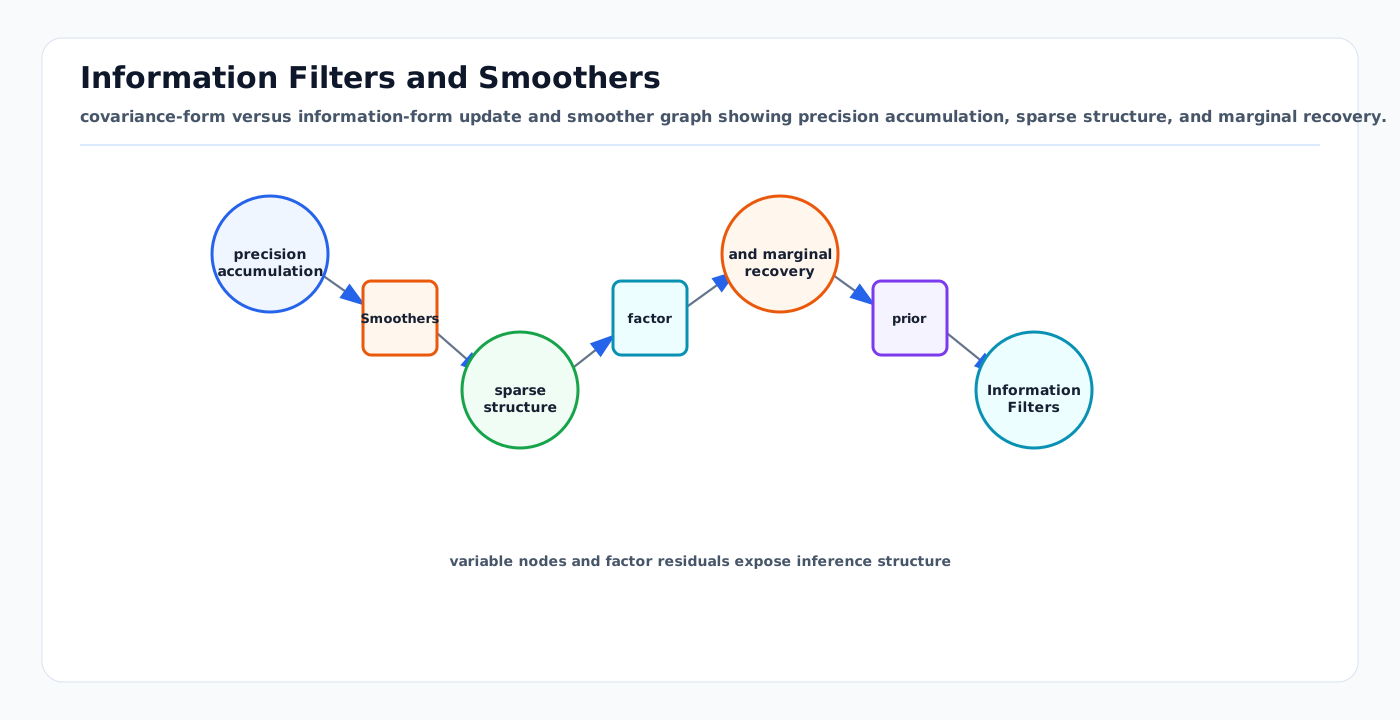
Visual: covariance-form versus information-form update and smoother graph showing precision accumulation, sparse structure, and marginal recovery.
Information filters and smoothers express state estimation in terms of precision, constraints, and factorized evidence. The first-principles shift is from "what is the covariance of the state?" to "what information has each measurement contributed about the state?" That representation is especially useful when measurement factors are sparse and when delayed information should revise a short trajectory segment rather than only the latest state.
Related docs
- Bayesian Filtering and Error-State Kalman Filters
- GTSAM Factor Graph Optimization
- Data Association and Gating
- Time Sync, PTP, Timestamping, and Latency Models
- Benchmarking, Metrics, and Statistical Validity
Why it matters for AV, perception, SLAM, and mapping
AV localization and mapping systems do not only estimate a current pose. They also integrate delayed camera frames, LiDAR scans, IMU preintegration, wheel odometry, GNSS fixes, map constraints, loop closures, and calibration factors. Filtering gives low latency, but smoothing gives consistency when evidence arrives late or constrains multiple poses.
Information form is a natural fit for SLAM because most measurements touch only a few variables. A visual feature factor may touch one camera pose and one landmark. An IMU factor touches adjacent states. A loop closure touches two poses far apart in time. Sparse information matrices and factor graphs exploit that structure.
Core math and algorithm steps
Gaussian information form
A Gaussian can be written in moment form:
p(x) = N(x; mu, P)or information form:
Lambda = P^-1
eta = Lambda * mu

p(x) proportional to exp(
  -0.5 * x^T Lambda x + eta^T x
)
Recover moment form by:
P = Lambda^-1
mu = P * eta
Information form makes independent Gaussian evidence additive.
Linear measurement update
For:
z = H x + v, v ~ N(0, R)the measurement contributes:
Lambda_meas = H^T R^-1 H
eta_meas = H^T R^-1 z
Update:
Lambda_new = Lambda_pred + Lambda_meas
eta_new = eta_pred + eta_meas
This additive structure is the same principle behind normal equations in least squares and factor graphs.
Prediction in information form
For dynamics:
x_k = F x_{k-1} + w, w ~ N(0, Q)prediction is easier in covariance form:
P_pred = F P F^T + Q
mu_pred = F mu
Information filters either convert through covariance, use matrix identities, or augment/eliminate variables in a factor graph. In sparse SLAM, the latter is often preferable.
Batch smoothing as least squares
For a trajectory X = {x_0, ..., x_T} and factors r_i(X_i):
min_X sum_i || r_i(X_i) ||^2_{Sigma_i^-1}where:
||r||^2_A = r^T A rLinearizing nonlinear factors around the current estimate gives:
r(x + dx) ~= r(x) + J dxSolve the normal equations:
(J^T W J) dx = -J^T W rHere J^T W J is the information matrix. Sparse solvers exploit the fact that each factor only touches a small subset of variables.
Fixed-lag smoothing
Fixed-lag smoothing keeps a sliding window:
X_window = {x_{t-L}, ..., x_t}and marginalizes older variables. This supports delayed measurements while bounding compute and memory:
add new factors
optimize active window
marginalize states older than lag L
publish current state and covariance/health
Marginalization creates a prior factor on the remaining variables. This prior can become dense, so practical systems choose variable ordering and window size carefully.
RTS smoother
For linear-Gaussian models, the Rauch-Tung-Striebel smoother runs a forward Kalman filter and a backward pass:
G_k = P_k F_k^T P_{k+1|k}^-1
x_k^s = x_k + G_k (x_{k+1}^s - x_{k+1|k})
P_k^s = P_k + G_k (P_{k+1}^s - P_{k+1|k}) G_k^T
This is a fixed-interval smoother: it estimates past states using future measurements.
Implementation notes
- Use filters for low-latency state output and smoothers for delayed, multi-state, or mapping constraints.
- Keep timestamps in the state graph. A delayed measurement should attach to the state at acquisition time, not arrival time.
- Use robust losses for scan matching, visual reprojection, and loop closure factors.
- Treat marginalization priors as approximations. Linearization point changes after marginalization can create inconsistency.
- Monitor solver health: residual distribution, number of iterations, factor errors by type, marginal covariance, and rejected robust factors.
- Use square-root methods or Cholesky factorization where possible instead of forming dense inverses.
- Keep information matrix sparsity visible in diagnostics. Fill-in is a runtime and numerical stability issue, not just an implementation detail.
Failure modes and diagnostics
| Failure mode | Symptom | Diagnostic |
|---|---|---|
| Bad linearization | Optimizer converges to wrong local minimum. | Residual increases or requires many relinearizations. |
| Dense marginal prior | Runtime grows after old states are removed. | Inspect fill-in and factor arity after marginalization. |
| Overconfident prior | Smoother rejects valid later measurements. | NEES/NIS too high after marginalization events. |
| Timestamp error | Smoother fits delayed evidence by bending trajectory. | Residuals correlate with speed or yaw rate. |
| Loop closure outlier | Map or trajectory jumps globally. | Large robust loss residual with high leverage. |
| Gauge freedom | Solver singular or drifting without anchors. | Rank deficiency, unbounded covariance in global pose. |
| Double-counted evidence | Covariance collapses unrealistically. | Same sensor information appears as raw factor and derived factor. |
Sources
- Sarkka, "Bayesian Filtering and Smoothing": https://users.aalto.fi/~ssarkka/pub/cup_book_online_20131111.pdf
- GTSAM FixedLagSmoother documentation: https://borglab.github.io/gtsam/fixedlagsmoother
- GTSAM factor graph concepts: https://gtsam.org/tutorials/intro.html
- Dellaert and Kaess, "Factor Graphs for Robot Perception": https://www.ri.cmu.edu/pub_files/2017/5/Dellaert17fnt.pdf
- Welch and Bishop, "An Introduction to the Kalman Filter": https://www.cs.unc.edu/~welch/media/pdf/kalman_intro.pdf
- Thrun, "Probabilistic Algorithms in Robotics": https://www.cs.cmu.edu/~thrun/papers/thrun.probrob.pdf