Sequence Models: RNNs, SSMs, Attention, and Mamba
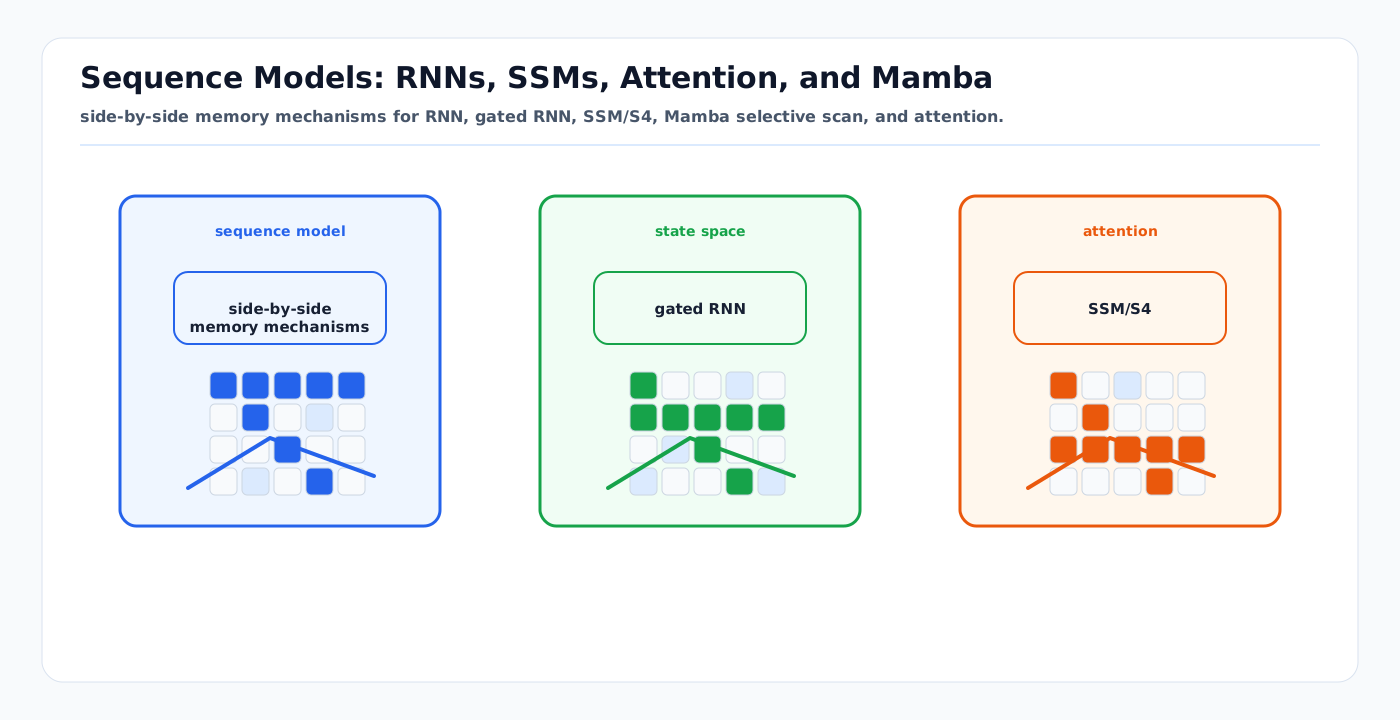
Visual: side-by-side memory mechanisms for RNN, gated RNN, SSM/S4, Mamba selective scan, and attention.
Scope
This note explains sequence modeling from first principles, from RNNs through S4, Mamba, Mamba-2, Mamba-3, and attention. It is intended for AV temporal perception, SLAM, mapping, tracking, and world-model readers. For driving-specific Mamba papers and deployment detail, see mamba-ssm-for-driving.md. For attention math, see attention-transformers-first-principles.md.
1. The Sequence Problem
A sequence model consumes ordered data:
x_1, x_2, ..., x_Tand predicts outputs:
y_1, y_2, ..., y_Tor a future:
x_{T+1:T+H}In AV systems, sequences appear everywhere:
- Camera frames.
- LiDAR sweeps.
- Radar tracks.
- BEV occupancy history.
- Ego states and controls.
- SLAM keyframes.
- Map updates over weeks.
- Agent trajectories.
The central design question is how information from the past influences the present.
2. RNNs: Fixed-Size Learned Memory
A recurrent neural network maintains a hidden state:
h_t = f(h_{t-1}, x_t)
y_t = g(h_t)
The hidden state is a fixed-size memory of the past. This is efficient:
Inference memory: O(d)
Per-step compute: O(d^2)
But simple RNNs struggle with long-range dependencies because gradients vanish or explode through many recurrent steps.
3. Gated RNNs: GRU and LSTM
LSTMs and GRUs add gates that decide what to write, keep, and forget.
The high-level idea:
new state = keep_gate * old_state + write_gate * candidate_stateGates make recurrent memory easier to train. They are still useful for small embedded systems, trackers, smoothing, and low-latency fusion.
Limitations:
- Training is less parallel than transformers.
- Fixed-size state can bottleneck detailed long histories.
- Memory content is implicit and hard to query exactly.
For SLAM and mapping, this means an RNN can summarize motion history but is a poor replacement for an explicit map or keyframe memory.
4. State Space Models
State space models (SSMs) come from dynamical systems. A continuous-time linear SSM is:
dh(t) / dt = A h(t) + B x(t)
y(t)      = C h(t) + D x(t)
After discretization:
h_t = A_bar h_{t-1} + B_bar x_t
y_t = C h_t + D x_t
This looks like an RNN, but with structured dynamics. The key advantage is that some SSMs can be computed either as recurrence or as convolution:
y = K * xThat gives two modes:
- Parallel convolution for training.
- Recurrent state updates for streaming inference.
5. S4
S4 made structured state spaces practical for long sequences. It uses a parameterization that preserves long-range memory while enabling efficient computation.
S4's first-principles contribution:
Use continuous-time state dynamics with structure,
then exploit that structure for efficient long-sequence modeling.
S4 was strong on long-range sequence benchmarks, but its parameters were mostly fixed across input content. That limits content-based selection. For language, perception, and world models, the model often needs to decide that this token is important while that token can be forgotten.
6. Mamba: Selective State Spaces
Mamba makes SSM parameters input-dependent:
B_t     = Linear_B(x_t)
C_t     = Linear_C(x_t)
Delta_t = softplus(Linear_Delta(x_t))
Then:
A_bar_t = exp(Delta_t A)
h_t = A_bar_t h_{t-1} + B_bar_t x_t
y_t = C_t h_t
This is "selective" because the current token controls how the state is updated and read. Some inputs preserve memory. Others reset or overwrite it.
Why it matters:
- Linear scaling in sequence length.
- Constant-size inference state.
- Better content sensitivity than fixed SSMs.
- Good fit for streaming sensor processing.
Mamba also introduced a hardware-aware selective scan, because input-dependent parameters prevent the simple convolution trick used by earlier SSMs.
7. Mamba-2: SSM and Attention Meet
Mamba-2 introduced structured state space duality (SSD), showing a close mathematical relationship between SSMs and variants of attention through structured semiseparable matrices.
The practical result is a new Mamba-2 layer that is faster than Mamba-1 and easier to map onto GPU matrix multiplications.
First-principles lesson:
The boundary between linear attention and SSM recurrence is not sharp.
Both can be seen as structured ways to move information forward in time.
This matters for AV models because it encourages hybrid designs: use attention where exact content lookup is needed, and use SSMs where long streaming memory is needed.
8. Mamba-3
Mamba-3, verified as an ICLR 2026 paper, focuses on inference-first linear sequence modeling. It adds:
- More expressive recurrence from SSM discretization.
- Complex-valued state updates for richer state tracking.
- Multi-input multi-output (MIMO) formulation to improve performance without increasing decode latency.
The paper reports improved retrieval, state-tracking, and downstream language modeling, including comparable perplexity to Mamba-2 with half the state size in state-size experiments.
For AV readers, the key implication is not that Mamba-3 should replace every transformer. It suggests that the linear-model frontier is moving toward better state tracking, which is exactly the weakness that matters for streaming autonomy.
9. Attention as Externalized Memory
Attention keeps past tokens available and computes content-based lookup:
y_t = sum_i weight(t, i) value_iFor causal inference, a transformer often uses a KV cache. The cache stores keys and values for all previous tokens.
Inference memory: O(T d)
Per-step lookup: O(T d)
This is expensive, but it supports exact retrieval from past tokens. If a rare event occurred 8 seconds ago, attention can directly attend to that token. A fixed recurrent state must have compressed it.
10. Comparison
| Model family | Training | Inference memory | Strength | Weakness |
|---|---|---|---|---|
| RNN/GRU/LSTM | Sequential or limited parallel | Constant | Simple streaming | Long memory bottleneck |
| S4 | Parallel convolution | Constant | Long continuous signals | Limited content selection |
| Mamba | Parallel scan | Constant | Selective streaming memory | Harder exact retrieval |
| Transformer attention | Fully parallel | Grows with context | Content lookup and global mixing | Quadratic training cost |
| Hybrid SSM-attention | Mixed | Mixed | Balance of memory and lookup | More design complexity |
11. AV Temporal Design Patterns
Streaming Perception
Use Mamba or RNN-style state for long, high-rate streams:
radar detections -> temporal SSM -> tracks
BEV features over 10 seconds -> Mamba -> temporal context
map-change observations -> SSM -> persistent evidence score
Local Reasoning
Use attention for short windows where exact interactions matter:
objects in current scene -> self-attention -> interactions
BEV tokens in local region -> window attention -> spatial context
trajectory candidates -> cross-attention -> cost volume
Memory Retrieval
Use explicit memory or attention for retrieval:
current place descriptor -> attention over map memory -> loop closure candidates
current map tile -> cross-attention to historical tile embeddings -> change detection
Hybrid Temporal World Model
Use attention for spatial tokens and SSM for time:
per-frame BEV transformer
    -> temporal Mamba over each BEV cell or object token
    -> future occupancy or trajectory head
This avoids full spatiotemporal attention over T * H * W tokens.
12. SLAM and Mapping Considerations
Sequence models in SLAM must respect geometry:
- Ego motion changes the coordinate frame.
- Sensor timestamps are not simultaneous.
- Loop closure depends on place identity, not just recent sequence state.
- Static map evidence should persist; dynamic object evidence should decay.
A good temporal neural layer usually sits after motion compensation:
sensor frame -> features -> ego-motion warp -> temporal model -> map updateWithout motion compensation, the model spends capacity learning vehicle motion instead of scene dynamics.
13. State Reset and Distribution Shift
Streaming models need reset rules:
- Start of route.
- Localization jump.
- Sensor dropout.
- Large time gap.
- Severe weather transition.
- Vehicle enters a different operational zone.
If the hidden state persists through a discontinuity, predictions can become confidently wrong. Production systems should expose state health and support explicit resets.
14. Choosing the Right Sequence Model
| Need | Recommendation |
|---|---|
| Short context, rich interactions | Transformer attention |
| Very long stream, fixed memory | Mamba or SSM |
| Tiny embedded model | GRU/LSTM |
| Precise map/place retrieval | Attention over explicit memory |
| Long video world model | Hybrid attention plus SSM or latent world model |
| Real-time tracking | Kalman/filter baseline plus learned temporal features |
| Safety-critical planning | Learned model plus explicit uncertainty and rule checks |
15. Relationship to Other Local Docs
- mamba-ssm-for-driving.md: driving-specific Mamba, MambaOcc, DriveMamba, and deployment.
- attention-transformers-first-principles.md: attention math and transformer blocks.
- transformer-world-models.md: GPT-style world-model transformer details.
- world-models-first-principles.md: model-based prediction and planning context.
- 30-autonomy-stack/perception/overview/streaming-temporal-perception.md: temporal perception context.
- 30-autonomy-stack/localization-mapping/overview/robust-state-estimation-multi-sensor.md: classical state-estimation counterpart.
Sources
- Gu et al., "Efficiently Modeling Long Sequences with Structured State Spaces" (S4). arXiv:2111.00396. https://arxiv.org/abs/2111.00396
- Gu and Dao, "Mamba: Linear-Time Sequence Modeling with Selective State Spaces." arXiv:2312.00752. https://arxiv.org/abs/2312.00752
- Dao and Gu, "Transformers are SSMs: Generalized Models and Efficient Algorithms Through Structured State Space Duality" (Mamba-2). arXiv:2405.21060. https://arxiv.org/abs/2405.21060
- Lahoti et al., "Mamba-3: Improved Sequence Modeling using State Space Principles." arXiv:2603.15569. https://arxiv.org/abs/2603.15569
- Vaswani et al., "Attention Is All You Need." arXiv:1706.03762. https://arxiv.org/abs/1706.03762