Robust Losses and M-Estimators: Huber, Cauchy, Tukey, and Geman-McClure
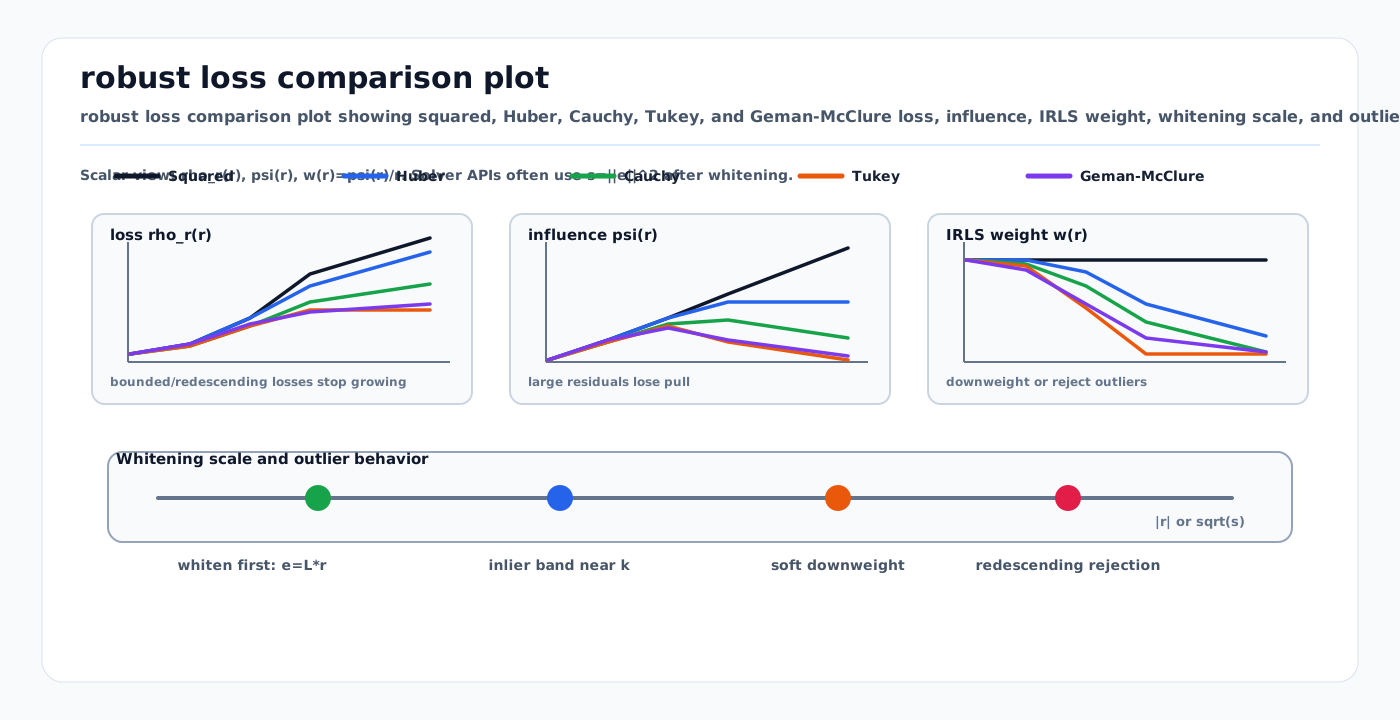
Visual: robust loss comparison plot showing squared, Huber, Cauchy, Tukey, and Geman-McClure loss, influence, IRLS weight, whitening scale, and outlier rejection behavior.
Robust losses are the small mathematical wrapper that keeps a large estimator from believing every residual equally. In SLAM, perception, calibration, and tracking, the residual model is often locally useful but globally imperfect: feature matches can be wrong, LiDAR points can belong to moving objects, radar returns can be ghosts, GNSS can jump under multipath, and labels can be noisy. Squared loss lets these residuals grow unlimited influence. Robust losses reduce that influence after a residual becomes too large to look like an inlier.
Related docs
- Robust Statistics, RANSAC, and Hypothesis Testing
- Likelihood, MAP, MLE, and Least Squares
- Gaussian Noise, Covariance, Information, Whitening, and Uncertainty Ellipses
- Mahalanobis and Chi-Square Gating
- Robust-Loss Covariance Consistency
- Nonlinear Least Squares from First Principles
- Factor Graph Solver Patterns: Ceres, GTSAM, and g2o
- GTSAM Factor Graph Optimization
- Point Cloud Registration Math: ICP, NDT, and GICP
- GLIM
Why it matters for SLAM and perception
Robust losses show up wherever a stack minimizes residuals:
- ICP and point-to-plane registration downweight dynamic objects, mixed pixels, rain or snow speckles, and bad nearest-neighbor matches.
- Visual odometry and bundle adjustment downweight wrong feature tracks, rolling-shutter artifacts, occlusions, and reprojection outliers.
- Pose graph SLAM downweights false loop closures and weak GPS or map priors.
- GNSS and radar fusion downweight multipath and ghost returns after gating.
- Perception training uses Smooth L1 or Huber-style losses for box regression when labels or decoded boxes have heavy-tailed errors.
The loss is not a substitute for the sensor model. A robust kernel should be applied after residuals are in comparable statistical units.
GTSAM and GLIM interpretation
GTSAM robust noise models wrap an ordinary Gaussian noise model with an M-estimator. Conceptually, the factor is still evaluated as a residual with Jacobians, but large whitened residuals receive reduced influence. This is different from front-end outlier rejection: robustification limits damage after a factor is present, while gating decides whether the factor should be added at all.
For GLIM-style mapping, robustification is usually needed at several levels:
| Source of outliers | Practical robust strategy |
|---|---|
| Moving vehicles, pedestrians, aircraft, baggage carts, or forklifts | dynamic-object filtering before factor creation plus robust scan residuals |
| False loop closures or repeated structures | geometric verification, conservative covariance, robust kernel, and possibly switchable constraints |
| GNSS multipath | chi-square gating, HDOP/fix-quality dependent covariance, and Huber/Cauchy-style robust factors |
| Mixed pixels, rain, dust, or reflective surfaces | point filtering and robust point/voxel residuals |
| Manual map-edit corrections | treat edits as explicit constraints with uncertainty, not as infinitely trusted truth |
Robust losses should be tuned in whitened units. If a loop closure residual is measured in meters and radians but is not correctly whitened, the robust threshold has no consistent meaning.
Core math
There are two related conventions to keep separate:
- A scalar teaching convention writes the loss as
rho_r(r), with influencepsi(r) = d rho_r(r) / d rand IRLS weightw(r) = psi(r) / r. - Many solver and library APIs take the squared whitened residual norm
s = ||e||^2, write the robustifier asrho_s(s), and use derivatives with respect tos. Library constants and factors of2therefore vary.
For a whitened scalar residual r, ordinary least squares minimizes:
rho_r(r) = 0.5 * r^2The influence function is:
psi(r) = d rho_r(r) / d rFor squared loss:
psi(r) = rInfluence grows without bound, so one very large residual can dominate the solution. An M-estimator replaces the quadratic penalty:
min_x sum_i rho_r(r_i(x))Many solvers implement this through iteratively reweighted least squares (IRLS):
w(r) = psi(r) / r
min_dx 0.5 * sum_i w(r_i) * (r_i + J_i dx)^2
For vector residual blocks in a solver, use the whitened squared norm:
e_i = L_i r_i
s_i = ||L_i r_i||^2
cost_i = rho_s(s_i)
where L_i is the square-root information matrix. Robust thresholds are then in whitened units, not raw meters, pixels, radians, or Doppler units.
Common robust losses
For residual r and scale k:
| Loss | Behavior | Typical use |
|---|---|---|
| Squared | Influence grows linearly forever. | Clean Gaussian inliers with reliable associations. |
| Huber | Quadratic near zero, linear after k. | General-purpose SLAM, GNSS, visual reprojection, and mild outliers. |
| Cauchy | Logarithmic growth for large residuals. | More aggressive scan matching and map localization outlier rejection. |
| Tukey bisquare | Redescending; large residuals get near-zero influence. | Good initialization with clear gross outliers. |
| Geman-McClure | Bounded, nonconvex, strong rejection. | Robust PGO, GNC schedules, and high-outlier loop closure problems. |
Huber loss:
rho_r(r) = 0.5 * r^2                 if |r| <= k
rho_r(r) = k * (|r| - 0.5 * k)       otherwise

w(r) = 1                           if |r| <= k
w(r) = k / |r|                     otherwise
Cauchy-style loss:
rho_r(r) = 0.5 * k^2 * log(1 + (r / k)^2)
w(r) = 1 / (1 + (r / k)^2)
Tukey bisquare:
rho_r(r) = (k^2 / 6) * (1 - (1 - (r / k)^2)^3)   if |r| <= k
rho_r(r) = k^2 / 6                               otherwise

w(r) = (1 - (r / k)^2)^2                       if |r| <= k
w(r) = 0                                       otherwise
Geman-McClure-style loss:
rho_r(r) = r^2 / (r^2 + k^2)
w(r) proportional to k^2 / (r^2 + k^2)^2
For Geman-McClure, that weight expression is up to constant normalization, depending on whether the loss is written as a scalar residual loss rho_r(r) or a squared-norm solver loss rho_s(s). The exact constants vary across libraries. The operational question is the same: how quickly should a residual lose influence as it leaves the inlier noise band?
Choosing a loss
| Situation | Prefer | Reason |
|---|---|---|
| First robustification pass | Huber | Convex and easier to optimize. |
| Scan matching with dynamic clutter | Cauchy or Huber | Keeps useful medium residuals while weakening strong outliers. |
| False loop closures after verification | GNC, switchable constraints, or Geman-McClure-style losses | Direct nonconvex robust losses can need a schedule or switch model. |
| Good initialization and gross outliers | Tukey or Geman-McClure | Redescending behavior can fully suppress bad measurements. |
| Poor initialization | Least squares, Huber, or graduated robustification | Strong redescending losses can ignore residuals needed for recovery. |
| Safety evidence and diagnostics | Huber plus gates and residual histograms | Easier to explain, tune, and audit. |
Use robust losses only on factors that can plausibly be outliers. IMU preintegration, odometry continuity, and hard frame constraints usually need different treatment from camera feature tracks, loop closures, radar detections, or GNSS fixes.
Whitening and scale
Robust loss scale should usually be set after whitening:
e = L * r
s = ||e||^2
cost = rho_s(s)
This is why a Huber threshold such as k = 1.345 means roughly "number of sigmas" in many factor-graph APIs, not 1.345 meters or pixels. If residuals are not whitened first, a threshold that works for LiDAR meters will be meaningless for camera pixels or IMU bias units.
Practical checks:
- Plot whitened residual histograms before and after robustification.
- Plot robust weights against residual magnitude.
- Separate residuals by sensor, range, class, weather, and map region.
- Log how many residuals are nearly ignored by a redescending loss.
- Compare pre-gate and post-gate innovation statistics to avoid selection bias.
Failure modes
| Symptom | Likely cause | Diagnostic |
|---|---|---|
| One sensor still dominates | Covariance is too tight before robustification. | Inspect per-factor whitened residuals and weights. |
| Good data is ignored | Robust threshold is too low. | Plot weights and inlier residual distribution. |
| Solver converges to a bad local minimum | Nonconvex loss was applied too early. | Start with Huber or use graduated nonconvexity. |
| Map jumps after a loop closure | Robust loss cannot fix a plausible but wrong association alone. | Add geometric verification, switchable constraints, or loop quarantine. |
| Validation looks good only after rejection | Selection bias from gates and robust weights. | Report pre-gate and post-gate statistics separately. |
| Robust kernel hides model bias | Residual model is wrong by range, class, weather, or timing. | Bin residuals by operating condition and fix the model. |
Sources
- Huber, "Robust Estimation of a Location Parameter": https://projecteuclid.org/journals/annals-of-mathematical-statistics/volume-35/issue-1/Robust-Estimation-of-a-Location-Parameter/10.1214/aoms/1177703732.full
- Ceres Solver, "LossFunction": https://ceres-solver.readthedocs.io/latest/nnls_modeling.html#lossfunction
- GTSAM Doxygen,
gtsam::noiseModel::Robust: https://gtsam.org/doxygen/a04491.html - SciPy,
scipy.optimize.least_squares: https://docs.scipy.org/doc/scipy-1.13.0/reference/generated/scipy.optimize.least_squares.html - Black and Rangarajan, "On the Unification of Line Processes, Outlier Rejection, and Robust Statistics with Applications in Early Vision": https://doi.org/10.1023/A:1008185302314