FMCW, MIMO, and Doppler Radar Fundamentals
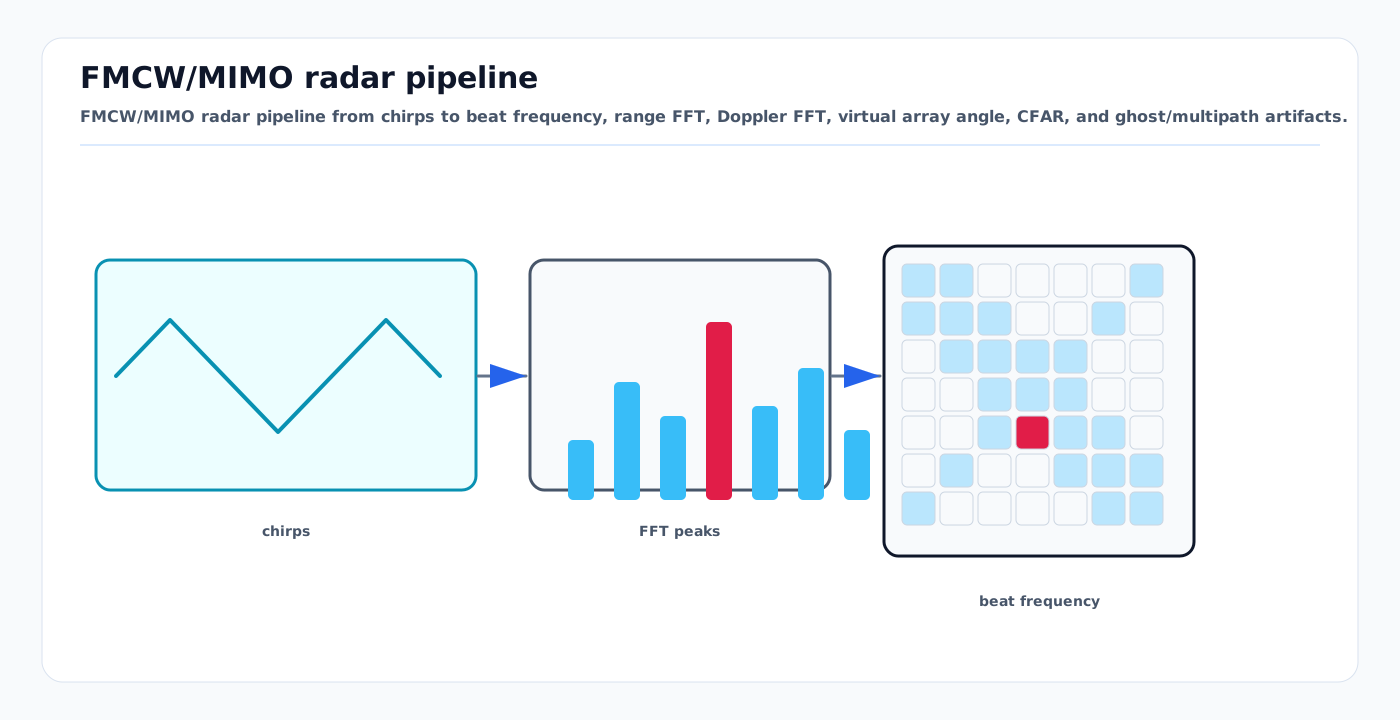
Visual: FMCW/MIMO radar pipeline from chirps to beat frequency, range FFT, Doppler FFT, virtual array angle, CFAR, and ghost/multipath artifacts.
Automotive and autonomy radars are active RF sensors. They measure range, angle, radial velocity, and reflected power through a signal-processing chain, not through direct geometric projection. Radar point clouds are sparse and noisy compared with LiDAR, but Doppler and weather robustness make radar a critical perception and localization sensor.
1. FMCW Range Measurement
Frequency-modulated continuous-wave (FMCW) radar transmits chirps whose frequency changes linearly over time:
f_tx(t) = f_c + S*t
S = B / T_chirp
The received echo is delayed by:
tau = 2*r / cMixing received and transmitted signals gives a beat frequency:
f_b ~= S * tau = 2*S*r/c
r = c*f_b/(2*S)
Range resolution is set by chirp bandwidth:
delta_r = c / (2*B)This is why 77 GHz radars with GHz-class bandwidth can resolve decimeter-scale range bins even though the carrier wavelength is millimeters.
2. Doppler Velocity
Doppler comes from phase change across chirps:
f_d = 2*v_r / lambda
v_r = lambda*f_d/2
In a chirp frame, radar usually performs:
Range FFT   over fast time samples within each chirp
Doppler FFT over slow time chirps in a frame
Angle FFT   over antenna channels
The output is a range-Doppler-angle cube. A detection point carries radial velocity relative to the radar:
v_r = dot(v_target - v_sensor, unit_ray)Radar does not directly measure tangential velocity. A crossing target can have near-zero Doppler even while moving fast.
Sensor Model Impact
| Task | Why the model matters |
|---|---|
| Perception | Doppler separates moving objects from static clutter and gives immediate velocity without tracking latency. |
| SLAM | Static radar detections can estimate ego velocity and constrain localization when LiDAR/camera degrade. |
| Mapping | Radar maps should store reflectors with RCS/Doppler stability, not assume dense geometry. |
| Validation | Radar must be validated by range, angle, Doppler, RCS, weather, multipath, and ego-motion bins. |
3. MIMO Angle Estimation
Multiple-input multiple-output (MIMO) radar uses several transmit and receive antennas to form a larger virtual array.
N_virtual = N_tx * N_rxFor a far-field target, phase differences across antennas encode angle:
delta_phase = 2*pi*d*sin(theta)/lambdaAngle estimation methods:
| Method | Strength | Risk |
|---|---|---|
| Angle FFT | fast and common | resolution limited by aperture and sidelobes |
| Beamforming/Capon | better interference handling | more compute and covariance sensitivity |
| MUSIC/ESPRIT | super-resolution in ideal conditions | fragile with multipath, coherent targets, calibration errors |
Angular resolution depends on aperture, wavelength, SNR, windowing, and target separation. Elevation requires a vertical aperture or planar array.
TDM-MIMO Doppler Coupling
Time-division multiplexed MIMO transmits different TX chirps at different times. Moving targets accumulate phase between TX slots. Angle processing must apply Doppler compensation; otherwise velocity appears as angle bias.
4. Radar Signal-Processing Pipeline
Typical processing:
ADC samples
  -> range FFT
  -> clutter/static removal or high-pass filtering
  -> Doppler FFT
  -> CFAR detection on range-Doppler map
  -> angle estimation on selected cells
  -> peak grouping / clustering
  -> tracking and classification
  -> point cloud and object list
Windowing trades resolution for sidelobe suppression:
rectangular: narrow main lobe, high sidelobes
Hann/Hamming: wider main lobe, lower sidelobes
Blackman: stronger sidelobe suppression, lower resolution
For fusion, it matters whether a radar point is a raw detection, clustered detection, or tracker output. Tracker outputs already include temporal model assumptions and should not be fused as independent raw measurements.
5. CFAR Detection
Constant false alarm rate (CFAR) adapts the detection threshold to local noise and clutter.
Cell-averaging CFAR:
noise_est = mean(training_cells)
threshold = alpha * noise_est
detect if cell_power > threshold
Guard cells around the test cell prevent target energy from contaminating the noise estimate.
CFAR variants:
| Variant | Use |
|---|---|
| CA-CFAR | homogeneous noise fields |
| GO-CFAR | clutter edges, choose greater side estimate |
| SO-CFAR | multiple targets, choose smaller side estimate |
| OS-CFAR | robust to interfering targets using ordered statistic |
CFAR defines what becomes a radar point. Low-RCS pedestrians, cones, and FOD may not cross threshold at long range, while bright metal objects can create many detections and sidelobes.
6. RCS, SNR, and Range Equation
Radar cross section (RCS) describes how strongly a target reflects energy back toward the radar. Received power follows the radar range equation:
P_r = P_t * G_t * G_r * lambda^2 * sigma /
      ((4*pi)^3 * R^4 * L)
where sigma is RCS and R is range. The R^4 loss is severe: double the range and received power falls by 16x for a point target.
SNR affects:
- detection probability
- range and Doppler peak precision
- angle estimation variance
- tracker covariance
RCS is not a stable object class label by itself. It changes with aspect angle, material, wetness, polarization, multipath, and target microstructure. Aircraft, GSE, jet bridges, signs, and wet ground can be strong reflectors.
7. Multipath, Ghosts, and Clutter
Radar multipath can create detections at geometrically impossible locations. Common causes:
- ground bounce
- building and terminal reflections
- aircraft fuselage reflections
- guardrails and fences
- mutual radar interference
- sidelobes from bright reflectors
Ghost symptoms:
position inconsistent with camera/LiDAR
Doppler inconsistent with apparent location
appears mirrored across a flat reflector
unstable over small ego-motion changes
high RCS but no physical object
Mitigation:
- fuse with LiDAR/camera occupancy when available
- use Doppler consistency and multi-frame tracking
- model static reflector maps for recurring ghost zones
- reject detections outside drivable/free-space constraints
- avoid overconfident radar angle covariance
8. Doppler Ego-Velocity Estimation
For a static object, measured radial velocity is caused by ego motion:
v_r_i = -dot(v_ego + omega_ego x p_i, unit_ray_i)With many static radar points, solve for ego velocity:
min_v sum_i rho( v_r_i + dot(v, unit_ray_i) )Use robust loss rho because dynamic objects and ghosts violate the static assumption.
Ego-Doppler is valuable when:
- wheel odometry slips on wet apron or snow
- GNSS velocity is unavailable or multipath-corrupted
- LiDAR scan matching is weak in rain/fog
- camera motion estimation fails in low light
Limitations:
- Requires enough static detections over diverse azimuths.
- Radial-only geometry is weak when all detections lie in one direction.
- Mount yaw error biases lateral velocity.
- TDM-MIMO and Doppler ambiguity handling must be correct.
9. Noise Models for Fusion
Radar detection measurement:
z = [r, azimuth, elevation, v_r, rcs]Approximate covariance:
Sigma_z = diag(sigma_r^2, sigma_az^2, sigma_el^2, sigma_vr^2)Starting guidance:
- Range is usually better than angle.
- Elevation is often worse than azimuth unless using high-channel 4D radar.
- Doppler is precise for radial motion but ambiguous if velocity wrapping or compensation is wrong.
- Inflate covariance for low SNR, low RCS, high sidelobe region, multi-target bins, and suspected multipath.
Cartesian covariance:
Sigma_xyz = J_polar_to_cartesian * Sigma_range_angle *
            J_polar_to_cartesian^T
For object tracking, keep radar measurement covariance separate from tracker state covariance. A vendor object list may already be filtered and correlated over time.
10. Radar-Camera and Radar-LiDAR Fusion
Fusion roles:
| Pair | Radar contribution | Other sensor contribution |
|---|---|---|
| Radar + camera | sparse metric depth, velocity, weather robustness | semantics, classification, lane/sign/light recognition |
| Radar + LiDAR | Doppler and adverse-weather continuity | dense geometry and object shape |
| Radar + IMU/wheel | ego-velocity cross-check | angular rate and short-term propagation |
| Radar + map | stable reflector landmarks | global frame and semantic constraints |
Practical hooks:
- Calibrate radar yaw/pitch/roll carefully; angle errors dominate at range.
- Time-align radar frames with ego motion; Doppler compensation uses the correct acquisition interval.
- Use radar to validate whether a LiDAR/camera object is moving.
- In rain/fog, raise radar weight but keep multipath/ghost gating active.
11. Failure Modes
| Failure mode | Cause | Mitigation |
|---|---|---|
| Ghost object | multipath or sidelobe | Doppler/geometry consistency, LiDAR/camera cross-check |
| Wrong velocity sign | frame or convention mismatch | projection tests with known approaching/receding targets |
| Angle bias | mount yaw/pitch error, antenna calibration | extrinsic calibration and residual monitoring |
| Doppler aliasing | velocity exceeds unambiguous range | ambiguity flags, multi-PRI schemes, tracker validation |
| Missed pedestrian/FOD | low RCS or CFAR threshold | multi-sensor fusion and detection tuning |
| Static clutter treated as movers | wrong ego compensation | IMU/wheel/GNSS/radar ego-motion consistency |
| Overconfident radar factor | sparse multipath-heavy points | robust kernels and covariance inflation |
12. Sources
- Texas Instruments, "MIMO Radar." SWRA554A application report. https://www.ti.com/lit/an/swra554a/swra554a.pdf
- Texas Instruments, "Introduction to mmWave Sensing: FMCW Radars." https://training.ti.com/intro-mmwave-sensing-fmcw-radars
- Richards, "Fundamentals of Radar Signal Processing." McGraw-Hill.
- Richards table of contents and radar signal processing topics. https://mrichards.ece.gatech.edu/tableofcontents/
- Patole et al., "Automotive radars: A review of signal processing techniques." IEEE Signal Processing Magazine, 2017.
- Sun et al., "Signal Processing for TDM MIMO FMCW Millimeter-Wave Radar Sensors." IEEE Access, 2021. https://doaj.org/article/daaa8af0eb8043a685faf1df71e5414d
- OpenRadar mmWave DSP documentation. https://openradar.readthedocs.io/en/latest/dsp/angle_estimation.html
- Roriz et al., "4D Millimeter-Wave Radar in Autonomous Driving: A Survey." https://arxiv.org/html/2306.04242v4