Cholesky, LDLT, and Normal Equations
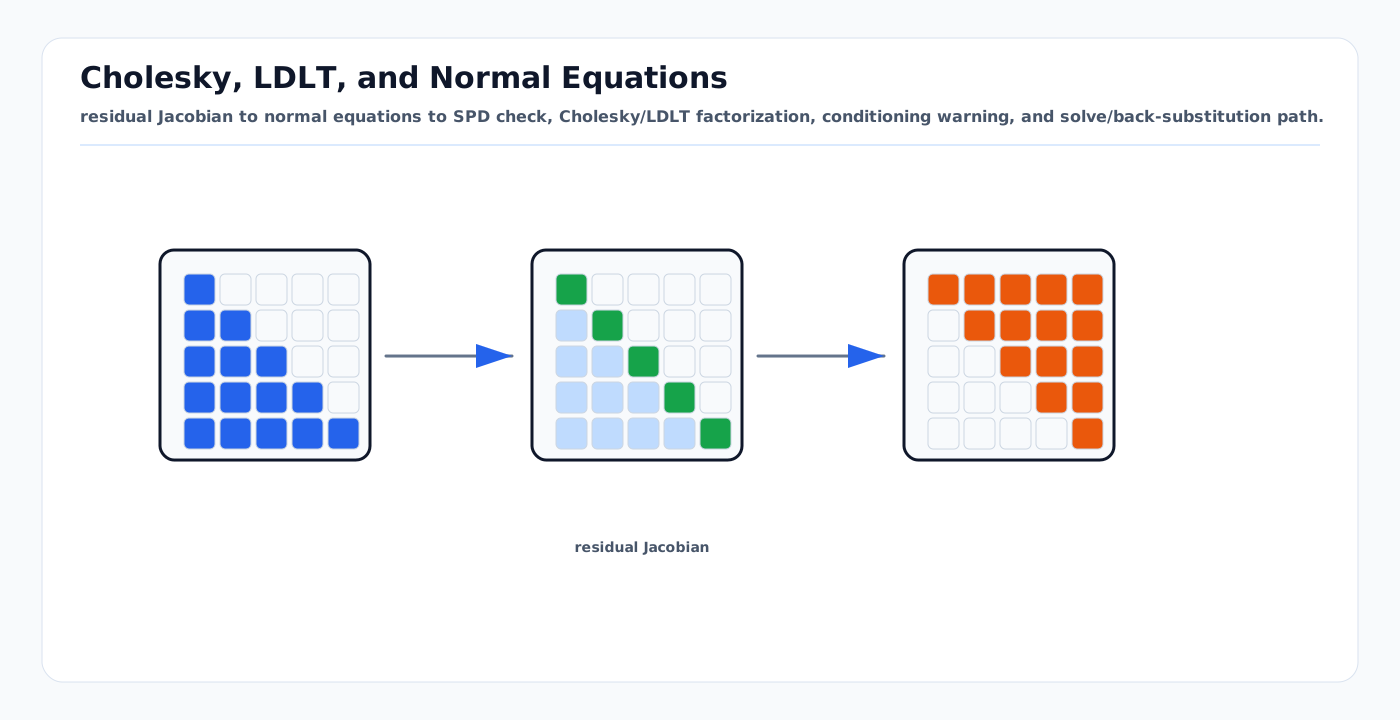
Visual: residual Jacobian to normal equations to SPD check, Cholesky/LDLT factorization, conditioning warning, and solve/back-substitution path.
Related docs
- QR, SVD, and Rank-Revealing Solvers
- Eigenvalues, Hessian Conditioning, and Observability
- Sparse Matrices, Fill-In, and Ordering
- Square-Root Information and Covariance Recovery
- Schur Complement, Marginalization, and PCG
- Sparse Estimation Backend Crosswalk
- Nonlinear Solver Diagnostics Crosswalk
- GTSAM Factor Graph Optimization
- GLIM
Why it matters for AV, perception, SLAM, and mapping
Most production SLAM, bundle adjustment, lidar mapping, calibration, and sensor fusion backends repeatedly solve linearized least-squares systems. After linearizing residuals around the current estimate, the computational hot path is often:
min_delta 0.5 ||J delta + r||_2^2The normal equations convert this into a symmetric system:
H delta = -g
H = J^T J
g = J^T r
With whitened residuals, J already includes the square-root information weighting. With explicit covariance Sigma, the same system is:
H = J^T Sigma^-1 J
g = J^T Sigma^-1 r
For AV workloads this is attractive because the Hessian is sparse, block structured, and symmetric. Pose graph SLAM, visual-inertial odometry, radar/lidar calibration, and offline HD map optimization all exploit this structure. The danger is that forming J^T J squares the condition number, hides rank deficiency, and makes Cholesky fail when the system is underconstrained, badly scaled, or only positive semidefinite because of gauge freedoms.
The practical rule is:
- Use Cholesky or LDLT when the linearized system is well constrained, well scaled, and performance dominates.
- Use QR or SVD when rank detection and numerical robustness matter more than speed.
- Treat Cholesky failure as a model or observability signal, not just as a linear algebra nuisance.
GTSAM and GLIM interpretation
GTSAM's fast path often relies on Cholesky-style sparse elimination of a positive definite linearized information system. That is appropriate when the graph is anchored, correctly whitened, and locally observable. If a GTSAM backend throws an indeterminate or indefinite linear-system exception, the detected variable is where factorization encountered the problem, not necessarily where the modeling error began.
For GLIM, a Cholesky failure or unstable normal-equation step should trigger this checklist:
| Check | Why |
|---|---|
| First-pose/map prior or gauge handling | relative-only graphs are semidefinite before gauge fixing |
| Scan geometry eigenvalues | flat, corridor, wall, and sparse scenes create weak pose directions |
| Noise scale ratios | overconfident LiDAR, GNSS, or plane factors can create numerical scale problems |
| Robust weights | redescending losses or bad weights can remove too much information locally |
| Marginalization prior | dense/stale priors can introduce bad conditioning or fake constraints |
| Hand-coded Hessian/Jacobian factors | wrong signs or dimensions can make an impossible SPD system |
Increasing LM damping can make a step computable, but it does not add real sensor information. If the graph is unobservable, fix the model or add a physically meaningful constraint.
Core math and algorithm steps
From residuals to normal equations
For residual block e_i(x) with covariance Sigma_i, define the whitened residual:
f_i(x) = L_i^-1 e_i(x), where Sigma_i = L_i L_i^TLinearize at x0:
f(x0 + delta) = f(x0) + J deltaThe Gauss-Newton step solves:
min_delta 0.5 ||J delta + f||_2^2Set the gradient to zero:
J^T (J delta + f) = 0
J^T J delta = -J^T f
H delta = b
where H = J^T J and b = -J^T f. If Levenberg-Marquardt damping is active, solve:
(H + lambda D^T D) delta = bwhere D is commonly a diagonal scaling matrix derived from diag(H).
Cholesky factorization
For symmetric positive definite H, Cholesky writes:
H = L L^Tor equivalently:
H = R^T RThe solve is:
L y = b
L^T delta = y
In sparse SLAM systems, the numeric factorization is usually preceded by symbolic analysis:
- Build the sparsity pattern of
H. - Choose a fill-reducing permutation
P. - Factor the permuted system:
P H P^T = L L^T- Solve in permuted coordinates, then unpermute the result.
The permutation is not a small implementation detail. It often determines whether the solver is real time or unusable.
LDLT factorization
LDLT writes a symmetric matrix as:
H = L D L^Twhere L is unit lower triangular and D is diagonal or block diagonal depending on the algorithm. In a positive definite problem, LDLT avoids square roots. In semidefinite or indefinite problems, pivoting and block pivots become important. Eigen's dense LDLT documentation is useful, but its own decomposition catalogue warns that Eigen's LDLT variant uses diagonal D and is not the same as a full indefinite Bunch-Kaufman style factorization.
For SLAM and mapping, LDLT is useful when:
- Damping or priors make the Hessian effectively positive definite.
- You want inertia-like diagnostics from pivots.
- You want to solve symmetric systems without explicitly taking square roots.
It is not a license to ignore gauge freedom. If a pose graph has no prior, the global translation and yaw modes are still null directions.
Normal equations and conditioning
If J has singular values sigma_i, then H = J^T J has eigenvalues:
lambda_i(H) = sigma_i(J)^2Therefore:
cond(H) = cond(J)^2This is the central tradeoff. Normal equations give a smaller symmetric system, but magnify conditioning problems. A visual SLAM Jacobian with weak parallax may look merely difficult in QR but nearly singular in Cholesky.
Implementation notes
Solver selection
Use Cholesky when all of these are true:
- The problem has enough priors or constraints to remove gauge freedoms.
- Residuals are whitened with realistic noise scales.
- Jacobian columns are reasonably scaled.
- Rank deficiency is not expected.
- You need maximum speed on large sparse systems.
Prefer LDLT when:
- The matrix is symmetric and close to semidefinite.
- You need more diagnostic information than plain LLT gives.
- The library implementation supports the definiteness class you need.
Prefer QR or SVD when:
- Calibrating sensors with weak excitation.
- Debugging a new factor, manifold convention, or residual scaling.
- Computing covariance in a potentially rank-deficient system.
- Handling single-camera landmarks, low-baseline triangulation, or missing priors.
Practical Cholesky workflow
For a nonlinear least-squares backend:
- Evaluate residuals and Jacobians at the current state.
- Whiten residuals and Jacobians using the square-root information factors.
- Assemble sparse block Hessian
Hand gradientg, or hand the block structure to a solver that assembles internally. - Apply robust loss scaling before forming
H. - Add damping if using LM:
H_damped = H + lambda diag(H)- Apply fill-reducing ordering.
- Factorize.
- If factorization succeeds, solve and evaluate the actual cost decrease.
- If factorization fails, inspect rank, priors, Jacobian scaling, and negative pivots before simply increasing damping.
Numerical scaling
Bad unit scaling is common in AV systems:
- Translation in meters, rotation in radians, velocity in m/s, bias in rad/s, and landmark inverse depth can differ by orders of magnitude.
- A GPS sigma of
0.02 mand a lidar scan-matching sigma of0.001 mcan dominate all other factors. - Pixel residuals and metric residuals must not be mixed without whitening.
Useful checks:
max_diag_H / min_positive_diag_H
max_column_norm_J / min_positive_column_norm_J
||H - H^T||_inf
||H delta - b|| / ||b||
actual_cost_drop / predicted_cost_drop
Damping is not a prior
LM damping can make a solve numerically possible, but it should not be interpreted as real information. If the global frame is unanchored, damping may choose a step but the posterior covariance still has gauge directions. For map publication, covariance queries, and loop closure consistency, use explicit priors or explicit gauge handling.
Concept cards
Cholesky
- What it means here: The standard sparse direct factorization for symmetric positive definite normal equations or information matrices.
- Math object:
H = L L^TorP H P^T = L L^T. - Effect on the solve: It gives fast triangular solves when the system is constrained, scaled, and SPD.
- What it solves: It efficiently computes a Gauss-Newton or LM linear step for large sparse estimation problems.
- What it does not solve: It does not diagnose rank deficiency as clearly as QR or SVD and cannot make a semidefinite gauge observable.
- Minimal example: A pose graph with a first-pose prior factors cleanly after fill-reducing ordering.
- Failure symptoms: Non-positive pivot, factorization exception, residual grows after solve, or warning reported near a misleading variable.
- Diagnostic artifact: Factorization status, pivot or diagonal log, permutation,
nnz(L), and linear residual||H delta - b|| / ||b||. - Normal vs abnormal artifact: A clean factorization with positive pivots and small residual is normal; a factorization warning is abnormal unless it matches an intentionally unanchored diagnostic case.
- First debugging move: Rebuild a representative problem as explicit whitened
J, then compare Cholesky against QR or SVD. - Do not confuse with: Sparse QR, which factors the Jacobian directly rather than
J^T J. - Read next: QR, SVD, and Rank-Revealing Solvers.
LDLT
- What it means here: A symmetric factorization that separates triangular structure from diagonal or block-diagonal pivots.
- Math object:
H = L D L^T, often with a permutation and library-specific pivoting behavior. - Effect on the solve: It can expose small, zero, or negative pivots more directly than plain Cholesky in diagnostic paths.
- What it solves: It solves symmetric linear systems and helps inspect definiteness when the backend supports the needed pivoting.
- What it does not solve: It does not remove the need for gauge fixing, damping, or a rank-revealing method in semidefinite problems.
- Minimal example: A damped Hessian factors with positive
Dentries while the undamped Hessian has zero gauge pivots. - Failure symptoms: Tiny or negative
Dentries, pivot growth, permutation changes, or unstable solutions under small perturbations. - Diagnostic artifact:
Dpivot values, block pivots if present, permutation, factorization status, and nearby variable key. - Normal vs abnormal artifact: Expected tiny pivots on declared gauge coordinates are normal in a debug run; negative pivots in a supposedly Gauss-Newton
J^T Jmatrix are abnormal. - First debugging move: Check symmetry and compare the assembled
HagainstJ^T Jon a small case. - Do not confuse with: Full indefinite factorization; some library
LDLTimplementations are not robust Bunch-Kaufman solvers. - Read next: Eigenvalues, Hessian Conditioning, and Observability.
Normal-equation conditioning
- What it means here: The numerical fragility introduced by solving through
H = J^T Jinstead of the original Jacobian least-squares problem. - Math object:
cond(J^T J) = cond(J)^2for full-rankJ. - Effect on the solve: Weak directions become much harder to resolve and double precision can lose meaningful digits.
- What it solves: It explains why a Cholesky step can be unstable even when QR on
Jis still usable. - What it does not solve: It does not identify the modeling cause of the weak direction by itself.
- Minimal example: If
cond(J) = 1e8, thencond(J^T J) = 1e16, near double precision limits. - Failure symptoms: Large normal-equation residual, QR/Cholesky disagreement, sensitivity to whitening, or noisy covariance in weak modes.
- Diagnostic artifact: Singular spectrum of
J, eigen-spectrum ofH, condition estimates, and comparison of QR versus normal-equation steps. - Normal vs abnormal artifact: Some condition-number growth is inherent when forming
J^T J; a warning-level squared condition number with unstable steps is abnormal for a production solve. - First debugging move: Compute
cond(J)andcond(H)on the same whitened representative matrix. - Do not confuse with: Fill-in, which is a sparsity and memory issue rather than a floating-point sensitivity issue.
- Read next: Sparse Estimation Backend Crosswalk.
Positive definiteness failure
- What it means here: The matrix presented to an SPD solver is singular, semidefinite, indefinite, asymmetric, or too numerically fragile for positive pivots.
- Math object: Failed SPD test or non-positive pivot in
H,H + lambda D^T D, or a Schur complement. - Effect on the solve: The linear step cannot be trusted from an SPD Cholesky path.
- What it solves: It converts a backend exception into a targeted diagnostic branch: rank, gauge, robust weights, marginalization, symmetry, or scaling.
- What it does not solve: It does not prove the first variable named in the exception caused the modeling bug.
- Minimal example: A pose graph without an anchor has a semidefinite Hessian and fails Cholesky.
- Failure symptoms: Non-positive pivot,
IndeterminantLinearSystemException, negative eigenvalue, NaNs after backsolve, or repeated LM damping increases. - Diagnostic artifact: Factorization warning, pivot location, symmetry norm
||H - H^T||, smallest eigenvalues, and variable neighborhood around the reported key. - Normal vs abnormal artifact: Failure is normal for an intentionally unanchored observability test; it is abnormal in a production graph that declares all gauges anchored and all robust weights valid.
- First debugging move: Add the minimal expected gauge anchor on a copy and see whether only the predicted failure disappears.
- Do not confuse with: Nonlinear cost rejection, where the linear solve succeeds but the trial state is not accepted.
- Read next: Nonlinear Solver Diagnostics Crosswalk.
Failure modes and diagnostics
Missing prior or gauge freedom
Symptoms:
- Cholesky reports non-positive pivot.
- The reported failing variable is not the true source.
- The trajectory can translate or rotate without changing residuals.
- Marginal covariance is huge or unavailable.
Diagnostics:
- Check that the first pose, map frame, scale, yaw, or gravity direction is anchored as appropriate.
- Inspect small eigenvalues of
H. - For visual SfM, check global similarity gauge: rotation, translation, and scale may be unobservable without constraints.
Degenerate geometry
Examples:
- Monocular landmarks observed from one camera or tiny baseline.
- Vehicle drives straight with no yaw excitation while estimating extrinsics.
- Planar lidar scans try to estimate full 6-DoF pose.
- Radar Doppler factors do not excite lateral or vertical states.
Diagnostics:
- Examine singular values of the relevant Jacobian block.
- Compare information added by each factor type.
- Run excitation-specific tests: turns, stops, vertical motion, nearby/far landmarks.
Indefinite Hessian
For pure Gauss-Newton with correctly formed residual Jacobians, J^T J is positive semidefinite. Indefinite H usually means:
- Hand-built Hessian factors are wrong.
- Robust loss second-order terms were applied incorrectly.
- Floating-point accumulation and poor conditioning introduced negative pivots.
- A marginalization prior was built at an inconsistent or stale linearization point.
Diagnostics:
- Rebuild from explicit Jacobian and compare with hand-built Hessian.
- Temporarily disable robust second-order corrections.
- Check symmetry after assembly.
- Try QR on the same linearized problem.
Squared condition number
If cond(J) is around 1e8, then cond(J^T J) is around 1e16, near double precision limits. Cholesky may return a step, but the step can be dominated by numerical error.
Diagnostics:
- Compare normal-equation step with QR on a smaller representative problem.
- Monitor residual after linear solve.
- Use iterative refinement only if the model is observable.
- Rescale variables and residuals before blaming the sparse solver.
Sources
- Ceres Solver, "Solving Non-linear Least Squares": https://ceres-solver.readthedocs.io/latest/nnls_solving.html
- Ceres Solver, "Covariance Estimation": https://ceres-solver.readthedocs.io/latest/nnls_covariance.html
- Eigen, "Catalogue of dense decompositions": https://eigen.tuxfamily.org/dox/group__TopicLinearAlgebraDecompositions.html
- Eigen, "LDLT class reference": https://eigen.tuxfamily.org/dox/classEigen_1_1LDLT.html
- SuiteSparse CHOLMOD user guide: https://github.com/DrTimothyAldenDavis/SuiteSparse/blob/dev/CHOLMOD/Doc/CHOLMOD_UserGuide.pdf
- GTSAM,
IndeterminantLinearSystemException: https://gtsam.org/doxygen/a04411.html - GTSAM tutorial, "Factor Graphs and GTSAM": https://gtsam.org/tutorials/intro.html