Sparse Estimation Backend Crosswalk
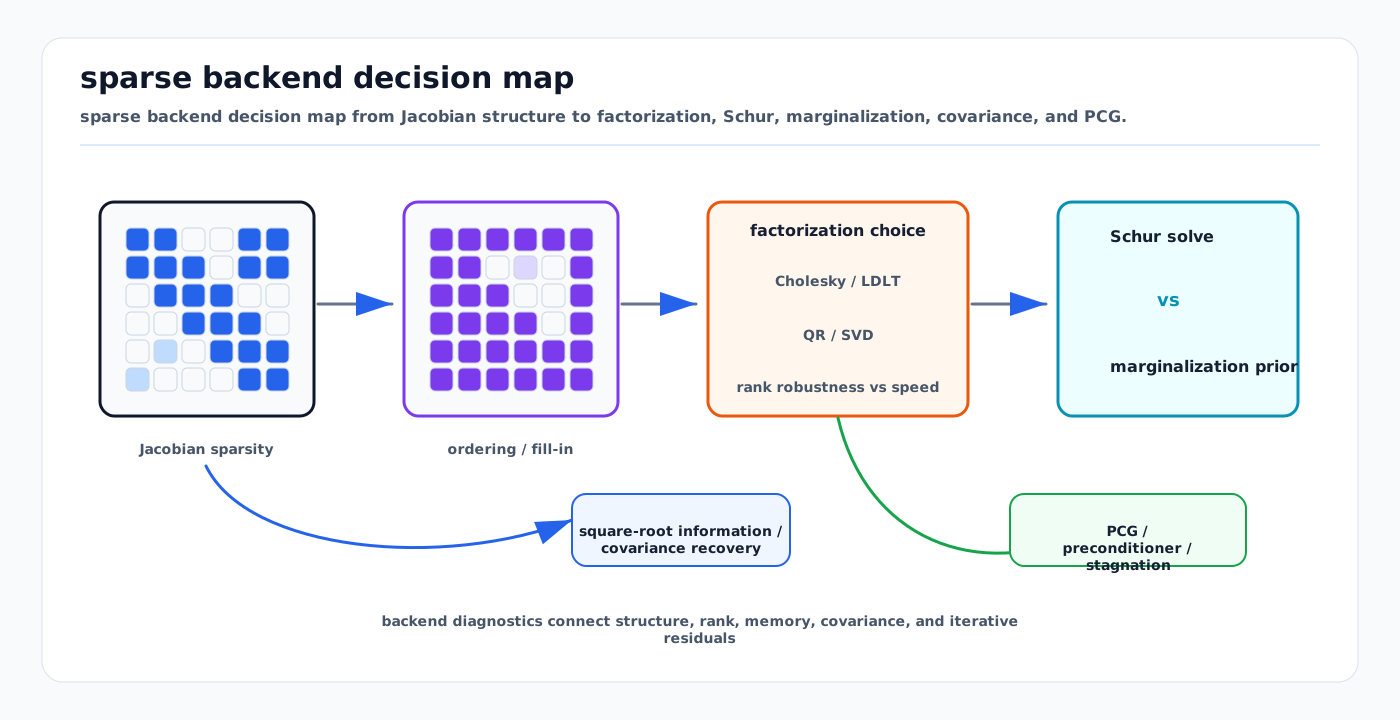
Visual: sparse backend decision map from Jacobian structure to factorization, Schur, marginalization, covariance, and PCG.
Related docs
- Nonlinear Solver Diagnostics Crosswalk
- Solver Selection and Convergence Diagnosis
- Cholesky, LDLT, and Normal Equations
- QR, SVD, and Rank-Revealing Solvers
- Eigenvalues, Hessian Conditioning, and Observability
- Sparse Matrices, Fill-In, and Ordering
- Schur Complement, Marginalization, and PCG
- Square-Root Information and Covariance Recovery
- GTSAM Factor Graph Optimization
- GLIM
Backend decision matrix
For GLIM and GTSAM-style SLAM, this page explains what happens below the method names. A fixed-lag odometry graph, a global submap graph, a loop-closure graph, and a map-refinement graph all reduce to sparse linearized systems after residuals are defined and whitened. When GLIM behaves unexpectedly, inspect this backend layer before blaming "the SLAM algorithm" as a whole.
Sparse Estimation Backend Crosswalk is the routing page for rank and nullspaces, sparsity, ordering, and fill-in, factorization, Schur complement for solving, marginalization prior construction, covariance recovery, and PCG stagnates diagnostics.
| Backend | SPD assumptions | Rank robustness | Sparsity/fill behavior | Covariance recovery | Runtime/memory | Diagnostic value |
|---|---|---|---|---|---|---|
| Cholesky | Requires symmetric positive definite normal equations or damped approximation. | Poor when rank deficient; failure is useful. | Very fast when ordering controls fill. | Selected covariance possible from factors if rank valid. | Excellent for well-posed sparse systems. | Factor failure exposes SPD, gauge, and conditioning issues. |
| LDLT | Handles symmetric indefinite systems better than Cholesky depending on pivoting. | More diagnostic for indefiniteness, still not full rank-revealing. | Fill depends on ordering and pivoting. | Useful for debugging signs and pivots. | Slightly higher overhead than Cholesky. | Pivots indicate indefiniteness or weak modes. |
| QR | Does not require normal-equation SPD. | More robust than normal equations. | Can create more fill than Cholesky but avoids squaring condition number. | Square-root covariance paths are natural. | More expensive but safer for debug and some production problems. | Reveals rank and conditioning better than normal equations. |
| SVD | No SPD assumption. | Strongest rank and nullspace diagnostic. | Usually dense or small-case tool. | Direct pseudoinverse and covariance diagnostics under threshold. | Expensive, often for reduced snapshots. | Best for explaining weak modes and threshold sensitivity. |
| Schur | Reduced system should be SPD after valid elimination and damping. | Depends on invertible eliminated blocks. | Can reduce problem size but create dense reduced blocks. | Camera/pose covariance possible, but fill and rank matter. | Excellent for bundle adjustment structure; risky for dense separators. | Separates eliminated-variable issues from kept-variable solve. |
| PCG | Requires symmetric positive definite matrix-vector operator. | Weak for rank diagnosis unless monitored carefully. | Avoids explicit factor fill; preconditioner controls convergence. | Not a covariance recovery method by itself. | Low memory, scalable if preconditioned well. | Residual norms and stagnation expose conditioning or operator bugs. |
Rank/nullspaces/conditioning
Rank and nullspaces answer whether the local linear system has enough independent information. Gauge freedom is an expected nullspace caused by arbitrary global coordinates such as pose-graph translation and yaw. Rank deficiency outside the expected gauge usually means missing constraints, bad geometry, or invalid elimination.
Conditioning is different. A weak mode can be technically observable while still producing fragile steps and misleading covariance. Rank thresholds, damping, and priors can make a system appear full rank while covariance remains nonsensical. The diagnostic sequence is: expected gauge dimension, singular spectrum, weak-mode vectors, condition estimate, then physical interpretation.
Sparsity/ordering/fill-in
Sparsity is the reason estimation backends are tractable. Each residual touches a small number of variables, so J, H, and square-root factors have exploitable block structure. Ordering decides which variables are eliminated first. Fill-in is the new nonzero structure created by elimination. A poor ordering or a dense marginalization prior can turn a sparse SLAM graph into a memory-heavy dense solve.
Inspect symbolic nonzeros, numeric nonzeros, elimination tree depth, separator size, and block structure. If runtime/memory grows suddenly after graph growth, open the fill report before changing nonlinear methods.
Schur/marginalization/covariance/PCG
Schur complement for solving eliminates variables inside one linear solve and then back-substitutes their updates. Marginalization prior construction removes variables from the active estimator and stores their information as a new prior over remaining separator variables. The algebra can look similar, but the lifecycle is different: solving is temporary, marginalization changes the future problem.
Square-root information stores normalized residual and factor structure without forming a dense covariance inverse. Covariance recovery extracts selected marginal covariance blocks from the local information system or square-root factor. Marginal covariance integrates out other variables; conditional covariance holds them fixed. The inverse of an information diagonal block is not generally a marginal covariance.
PCG requires an SPD operator, a preconditioner, and telemetry: unpreconditioned residual norm, preconditioned residual norm, iteration count, stopping tolerance, symmetry test for matrix-vector products, and nonlinear progress. Stagnation symptoms include residual norms flattening, iteration limits on many nonlinear steps, and accepted nonlinear progress disappearing even though linear work is high.
Concept cards
Rank deficiency
| Field | Explanation |
|---|---|
| What it means here | The linearized system lacks independent constraints in one or more directions. |
| Math object | Rank of J, R, or H; zero singular values. |
| Effect on the solve | Makes updates non-unique and covariance undefined without gauge handling. |
| What it solves | Diagnoses missing information and singular backends. |
| What it does not solve | It does not choose the physical anchor policy. |
| Minimal example | Relative pose graph with no fixed world pose. |
| Failure symptoms | Cholesky fails, covariance huge, solution drifts in global frame. |
| Diagnostic artifact | Singular values and nullspace basis. |
| Normal vs abnormal artifact | Normal nullspace matches expected gauge; abnormal nullspace contains constrained states. |
| First debugging move | Count expected gauge freedoms and compare with numeric rank. |
| Do not confuse with | Poor conditioning. |
| Read next | Eigenvalues, Hessian Conditioning, and Observability. |
Nullspace
| Field | Explanation |
|---|---|
| What it means here | Directions in state perturbation space that do not change residuals locally. |
| Math object | Vectors n such that J n = 0 or H n = 0. |
| Effect on the solve | Allows arbitrary motion unless constrained or projected out. |
| What it solves | Explains gauge freedoms and unobservable directions. |
| What it does not solve | It does not imply every weak mode is exactly unobservable. |
| Minimal example | Global yaw in a planar relative pose graph. |
| Failure symptoms | State changes with no cost change, singular covariance, anchor sensitivity. |
| Diagnostic artifact | Nullspace vectors visualized as state perturbations. |
| Normal vs abnormal artifact | Normal vectors match known symmetries; abnormal vectors reveal missing factors. |
| First debugging move | Apply a small nullspace perturbation and verify residual change. |
| Do not confuse with | Eigenvector of a small but nonzero eigenvalue. |
| Read next | QR, SVD, and Rank-Revealing Solvers. |
Gauge freedom
| Field | Explanation |
|---|---|
| What it means here | Arbitrary coordinates not determined by relative measurements. |
| Math object | Known nullspace basis or anchor constraint. |
| Effect on the solve | Requires fixing, projecting, or respecting gauge in covariance interpretation. |
| What it solves | Separates coordinate arbitrariness from physical uncertainty. |
| What it does not solve | It does not add real sensor information. |
| Minimal example | Fixing the first pose in SLAM. |
| Failure symptoms | Different absolute maps with same relative residual cost. |
| Diagnostic artifact | Gauge dimension and anchor sensitivity test. |
| Normal vs abnormal artifact | Normal gauge affects only arbitrary frame; abnormal anchor changes relative geometry. |
| First debugging move | Remove the anchor and inspect expected singular modes. |
| Do not confuse with | Prior knowledge. |
| Read next | SLAM/VIO Observability, FEJ, and Nullspace Consistency. |
Condition number
| Field | Explanation |
|---|---|
| What it means here | Ratio between strongest and weakest constrained directions. |
| Math object | kappa(A) = sigma_max / sigma_min. |
| Effect on the solve | Controls numerical sensitivity and PCG convergence. |
| What it solves | Quantifies weak-mode fragility. |
| What it does not solve | It does not identify wrong residual semantics by itself. |
| Minimal example | Low-parallax triangulation with tiny depth information. |
| Failure symptoms | Slow PCG, noisy covariance, unstable small pivots. |
| Diagnostic artifact | Spectrum, condition estimate, weak eigenvectors. |
| Normal vs abnormal artifact | Normal spectrum has expected weak directions; abnormal spectrum spans many orders unexpectedly. |
| First debugging move | Check scaling and whitening before changing factorization. |
| Do not confuse with | Exact rank deficiency. |
| Read next | Eigenvalues, Hessian Conditioning, and Observability. |
Sparsity
| Field | Explanation |
|---|---|
| What it means here | Most Jacobian or Hessian blocks are zero because factors touch few variables. |
| Math object | Block sparse J, H, or factor graph adjacency. |
| Effect on the solve | Enables real-time memory and runtime scaling. |
| What it solves | Avoids dense linear algebra on large estimation problems. |
| What it does not solve | It does not guarantee low fill after elimination. |
| Minimal example | Odometry factor touches only two neighboring poses. |
| Failure symptoms | Unexpected dense rows, memory growth, slow symbolic phase. |
| Diagnostic artifact | Sparsity plot and block adjacency graph. |
| Normal vs abnormal artifact | Normal pattern follows factor topology; abnormal pattern has broad accidental coupling. |
| First debugging move | Print each residual block's parameter dependencies. |
| Do not confuse with | Fill-in. |
| Read next | Sparse Matrices, Fill-In, and Ordering. |
Fill-in
| Field | Explanation |
|---|---|
| What it means here | New nonzeros created during elimination or factorization. |
| Math object | Nonzero pattern of factor L, R, or reduced system. |
| Effect on the solve | Increases memory, runtime, and covariance recovery cost. |
| What it solves | It is not a solver; it explains factorization growth. |
| What it does not solve | It does not indicate model accuracy. |
| Minimal example | Eliminating a pose connects all neighboring landmarks or poses. |
| Failure symptoms | Runtime/memory explodes after graph growth. |
| Diagnostic artifact | Symbolic fill report and elimination tree. |
| Normal vs abnormal artifact | Normal fill grows predictably; abnormal fill jumps after ordering or marginalization. |
| First debugging move | Compare fill under alternative orderings on the same graph. |
| Do not confuse with | Original sparsity. |
| Read next | Sparse Matrices, Fill-In, and Ordering. |
Ordering
| Field | Explanation |
|---|---|
| What it means here | Variable elimination sequence used by the sparse backend. |
| Math object | Permutation matrix or ordered variable list. |
| Effect on the solve | Controls fill, separator size, and Schur structure. |
| What it solves | Reduces runtime and memory by exploiting graph topology. |
| What it does not solve | It does not repair rank deficiency. |
| Minimal example | Eliminating landmarks before cameras in bundle adjustment. |
| Failure symptoms | Direct solve becomes dense, Schur reduced matrix too large. |
| Diagnostic artifact | Ordering report and fill comparison. |
| Normal vs abnormal artifact | Normal ordering respects block structure; abnormal ordering creates large cliques. |
| First debugging move | Run AMD/COLAMD or domain-specific ordering and compare nonzeros. |
| Do not confuse with | Solver method choice. |
| Read next | Sparse Matrices, Fill-In, and Ordering. |
Cholesky
| Field | Explanation |
|---|---|
| What it means here | Factorization for SPD normal equations or information matrices. |
| Math object | H = L L^T or R^T R. |
| Effect on the solve | Fast direct solve when assumptions hold. |
| What it solves | Efficient sparse SPD systems. |
| What it does not solve | It does not handle rank deficiency robustly. |
| Minimal example | Damped pose-graph normal equations after gauge anchor. |
| Failure symptoms | Non-positive pivot, factorization abort, huge condition warning. |
| Diagnostic artifact | Pivot log and factor nonzeros. |
| Normal vs abnormal artifact | Normal pivots positive and stable; abnormal pivots vanish or turn negative. |
| First debugging move | Check SPD assumptions, gauge, and whitening. |
| Do not confuse with | QR on the original least-squares system. |
| Read next | Cholesky, LDLT, and Normal Equations. |
LDLT
| Field | Explanation |
|---|---|
| What it means here | Symmetric factorization that exposes diagonal or block pivots. |
| Math object | P^T H P = L D L^T. |
| Effect on the solve | Can diagnose indefiniteness and handle some symmetric systems better than Cholesky. |
| What it solves | Symmetric systems where pivot information matters. |
| What it does not solve | It is not a full rank-revealing replacement for SVD. |
| Minimal example | Debugging an indefinite Hessian approximation. |
| Failure symptoms | Negative or tiny pivots, pivoting instability. |
| Diagnostic artifact | D pivots and permutation. |
| Normal vs abnormal artifact | Normal pivots match expected definiteness; abnormal pivots reveal sign or rank problems. |
| First debugging move | Inspect pivot sequence and compare with damped Cholesky. |
| Do not confuse with | LM damping. |
| Read next | Cholesky, LDLT, and Normal Equations. |
QR
| Field | Explanation |
|---|---|
| What it means here | Least-squares factorization that avoids forming normal equations. |
| Math object | J = Q R. |
| Effect on the solve | Improves numerical behavior for ill-conditioned least squares. |
| What it solves | More robust linearized least-squares solves. |
| What it does not solve | It does not make a wrong residual correct. |
| Minimal example | Debugging calibration Jacobians without squaring condition number. |
| Failure symptoms | Higher runtime but stable answer compared with Cholesky failure. |
| Diagnostic artifact | R diagonal and rank estimate. |
| Normal vs abnormal artifact | Normal R has clear rank; abnormal has tiny diagonals in expected constrained modes. |
| First debugging move | Compare QR step with normal-equation step on a small case. |
| Do not confuse with | SVD rank thresholding. |
| Read next | QR, SVD, and Rank-Revealing Solvers. |
SVD
| Field | Explanation |
|---|---|
| What it means here | Factorization that exposes singular values and vectors directly. |
| Math object | J = U Sigma V^T. |
| Effect on the solve | Gives best local rank and nullspace diagnosis. |
| What it solves | Small or reduced rank-revealing debug problems. |
| What it does not solve | It is usually too expensive for full production sparse graphs. |
| Minimal example | Explaining weak yaw/scale mode in a calibration snapshot. |
| Failure symptoms | Singular values collapse, threshold changes covariance dramatically. |
| Diagnostic artifact | Singular spectrum and right singular vectors. |
| Normal vs abnormal artifact | Normal tiny singular vectors match known gauge; abnormal vectors reveal missing excitation. |
| First debugging move | Visualize the weakest singular vector as a state perturbation. |
| Do not confuse with | Eigenanalysis of a damped Hessian without interpreting damping. |
| Read next | QR, SVD, and Rank-Revealing Solvers. |
Schur complement
| Field | Explanation |
|---|---|
| What it means here | Algebraic elimination of a variable block to solve a reduced system. |
| Math object | S = B - E C^-1 E^T. |
| Effect on the solve | Reduces system size and exploits conditional independence. |
| What it solves | Landmark-heavy bundle adjustment and related block systems. |
| What it does not solve | It does not mean permanent marginalization by itself. |
| Minimal example | Eliminate points, solve camera system, back-substitute point updates. |
| Failure symptoms | Singular eliminated block, dense reduced matrix, wrong back-substitution. |
| Diagnostic artifact | Block ranks, Schur nonzeros, reduced residual. |
| Normal vs abnormal artifact | Normal eliminated blocks are invertible; abnormal blocks need damping or removal. |
| First debugging move | Validate C^-1 block solves on representative landmarks. |
| Do not confuse with | Marginalization prior. |
| Read next | Schur Complement, Marginalization, and PCG. |
Marginalization prior
| Field | Explanation |
|---|---|
| What it means here | Prior factor created after removing variables from the active estimator. |
| Math object | Schur-reduced information and right-hand side over separator variables. |
| Effect on the solve | Preserves old information but can introduce dense couplings and stale linearization. |
| What it solves | Keeps fixed-lag smoothing bounded. |
| What it does not solve | It does not remain exact after large future relinearization changes. |
| Minimal example | Marginalize old poses and keep a prior on the newest boundary poses. |
| Failure symptoms | Dense prior explosion, overconfident estimator, loop closure fights prior. |
| Diagnostic artifact | Prior residual, prior matrix sparsity, linearization point. |
| Normal vs abnormal artifact | Normal prior separator is controlled; abnormal prior grows dense and stale. |
| First debugging move | Track separator size and prior nonzeros at every marginalization. |
| Do not confuse with | Schur complement for a temporary solve. |
| Read next | Out-of-Sequence Measurements and Fixed-Lag Smoothing. |
Square-root information
| Field | Explanation |
|---|---|
| What it means here | Factor form of information used to whiten residuals or represent solved factors. |
| Math object | L where L^T L = Sigma^-1, or QR factor R. |
| Effect on the solve | Avoids explicit dense inverses and keeps normalized residuals. |
| What it solves | Stable weighting and selected covariance workflows. |
| What it does not solve | It does not avoid rank analysis. |
| Minimal example | Premultiply pose residual by inverse square-root covariance. |
| Failure symptoms | Double whitening, bad scale, covariance mismatch. |
| Diagnostic artifact | L, R, and whitened residual checks. |
| Normal vs abnormal artifact | Normal factor reconstructs information; abnormal factor has wrong units or order. |
| First debugging move | Verify L^T L against intended information. |
| Do not confuse with | Covariance square root. |
| Read next | Square-Root Information and Covariance Recovery. |
Covariance recovery
| Field | Explanation |
|---|---|
| What it means here | Extracting selected local uncertainty from information or square-root factors. |
| Math object | Blocks of H^-1, marginal covariance, or pseudoinverse under rank handling. |
| Effect on the solve | Used after solving for diagnostics, gating, and integrity checks. |
| What it solves | Provides local uncertainty when gauge and rank assumptions are explicit. |
| What it does not solve | It does not validate global consistency. |
| Minimal example | Recover camera pose marginal covariance after sparse BA. |
| Failure symptoms | Negative variance, overconfident weak mode, dense inverse memory blowup. |
| Diagnostic artifact | Selected covariance block, rank threshold, factor backsolve trace. |
| Normal vs abnormal artifact | Normal block is positive and gauge-aware; abnormal block changes wildly with anchor. |
| First debugging move | Compare selected covariance against SVD on a small snapshot. |
| Do not confuse with | Measurement covariance. |
| Read next | Square-Root Information and Covariance Recovery. |
PCG
| Field | Explanation |
|---|---|
| What it means here | Iterative method for large SPD systems using matrix-vector products. |
| Math object | Preconditioned conjugate gradient iterations for A x = b. |
| Effect on the solve | Reduces memory but makes convergence depend on conditioning and preconditioning. |
| What it solves | Large sparse or implicit Schur systems where direct factorization is too expensive. |
| What it does not solve | It does not work on indefinite or nonsymmetric operators. |
| Minimal example | Iterative Schur solve for large bundle adjustment. |
| Failure symptoms | PCG stagnates, reaches iteration limit, nonlinear cost stops improving. |
| Diagnostic artifact | Unpreconditioned and preconditioned residual norms, iteration count, tolerance. |
| Normal vs abnormal artifact | Normal residuals decrease with accepted nonlinear progress; abnormal residuals flatten or oscillate. |
| First debugging move | Test symmetry and compare to a direct solve on a small case. |
| Do not confuse with | Schur complement itself. |
| Read next | Schur Complement, Marginalization, and PCG. |
Preconditioner
| Field | Explanation |
|---|---|
| What it means here | Approximation that improves PCG convergence by reshaping the linear system. |
| Math object | Matrix or operator M approximating A or A^-1. |
| Effect on the solve | Changes iteration count and residual decay. |
| What it solves | Reduces effective condition number for iterative solves. |
| What it does not solve | It does not fix an invalid SPD assumption. |
| Minimal example | Block-Jacobi preconditioner for pose blocks. |
| Failure symptoms | Many PCG iterations, residual plateaus, nonlinear budget wasted. |
| Diagnostic artifact | Preconditioned residual norm and iteration comparison. |
| Normal vs abnormal artifact | Normal preconditioner improves decay; abnormal preconditioner has little effect or breaks symmetry. |
| First debugging move | Compare identity, diagonal, and block preconditioners on the same snapshot. |
| Do not confuse with | Whitening or LM damping. |
| Read next | Schur Complement, Marginalization, and PCG. |
Sources
- Ceres Solver, "Solving Non-linear Least Squares": https://ceres-solver.readthedocs.io/latest/nnls_solving.html
- Davis, "Direct Methods for Sparse Linear Systems": https://people.engr.tamu.edu/davis/publications.html
- Saad, "Iterative Methods for Sparse Linear Systems" homepage: https://www-users.cse.umn.edu/~saad/books.html
- Dellaert and Kaess, "Square Root SAM": https://www.cc.gatech.edu/~dellaert/pubs/Dellaert06ijrr.pdf
- Triggs, McLauchlan, Hartley, and Fitzgibbon, "Bundle Adjustment - A Modern Synthesis": https://www.cs.jhu.edu/~misha/ReadingSeminar/Papers/Triggs00.pdf