Sparse Matrices, Fill-In, and Ordering
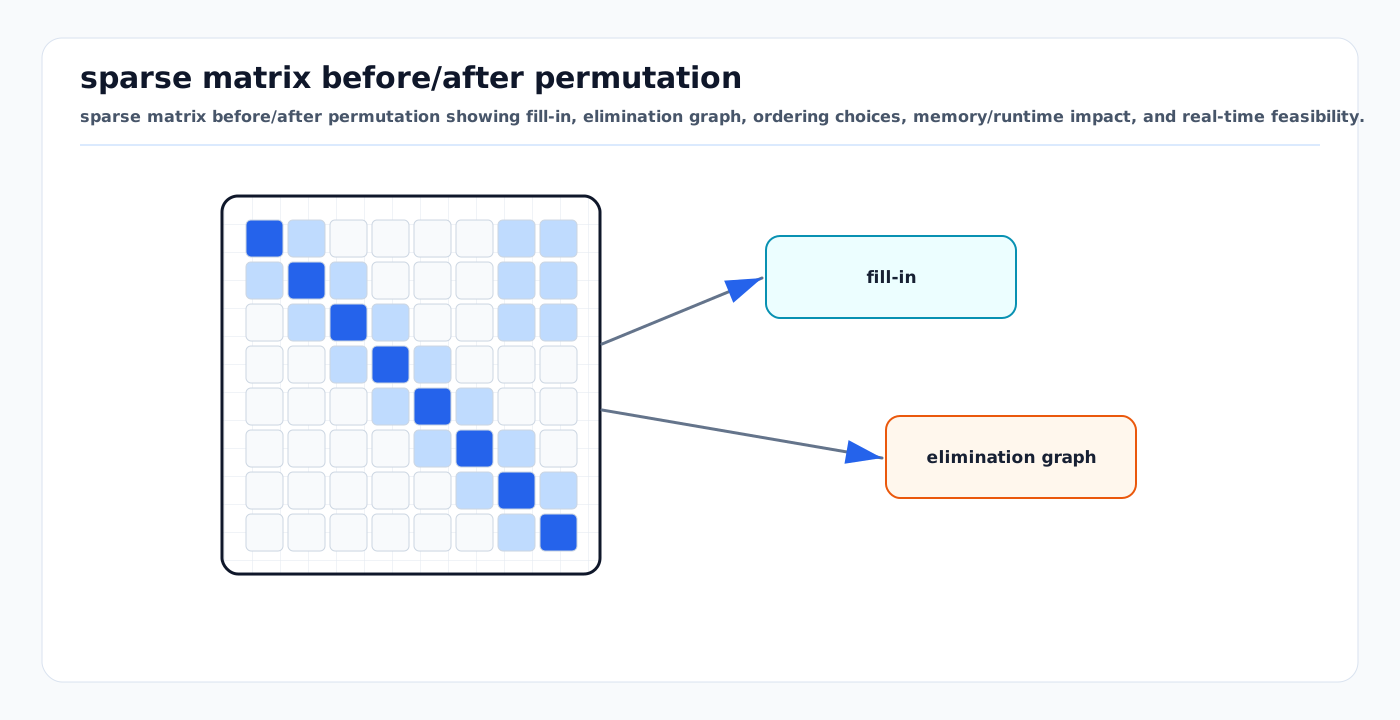
Visual: sparse matrix before/after permutation showing fill-in, elimination graph, ordering choices, memory/runtime impact, and real-time feasibility.
Related docs
- Cholesky, LDLT, and Normal Equations
- QR, SVD, and Rank-Revealing Solvers
- Eigenvalues, Hessian Conditioning, and Observability
- Square-Root Information and Covariance Recovery
- Schur Complement, Marginalization, and PCG
- Sparse Estimation Backend Crosswalk
- Nonlinear Solver Diagnostics Crosswalk
- GTSAM Factor Graph Optimization
- GLIM
Why it matters for AV, perception, SLAM, and mapping
SLAM and mapping problems are sparse because each measurement touches only a few variables. A wheel odometry factor touches two poses. A reprojection factor touches one camera and one landmark. An IMU factor touches adjacent poses, velocities, and biases. A loop closure touches two distant poses.
Sparse linear algebra is what makes large-scale mapping possible. But sparsity in the input matrix does not guarantee sparsity in the factor. During elimination, new nonzeros appear. This is fill-in. The variable ordering can change memory use and solve time by orders of magnitude.
For AV systems, fill-in determines:
- Whether local SLAM runs within a real-time budget.
- Whether offline map optimization fits in memory.
- Whether marginalization creates dense priors that slow every future update.
- Whether camera-landmark bundle adjustment scales to city-scale mapping.
- Whether a solver should use direct sparse factorization, Schur complement, or PCG.
GTSAM and GLIM interpretation
GTSAM's factor graph API hides most sparse matrix assembly, but it does not remove sparse linear algebra. When a NonlinearFactorGraph is linearized, factor Jacobians define a sparse Gaussian graph. Variable elimination creates conditionals, fill-in, and eventually a Bayes net or Bayes tree. Ordering decides whether that structure stays tractable.
In a GLIM-style pipeline:
| Graph region | Sparsity pattern | Ordering/fill-in concern |
|---|---|---|
| Odometry fixed-lag window | mostly temporal chain with IMU and scan factors across adjacent states | usually local, but dense marginal priors can grow on the window boundary |
| Submap graph | pose/submap nodes with registration and loop factors | loop closures can connect distant cliques and trigger larger re-elimination |
| Multi-session merge | session-level anchors plus cross-session loop factors | wrong or dense session links can create expensive global separators |
| Plane/GNSS/custom factors | unary or low-arity constraints | cheap individually, but shared calibration or map-frame variables can become high-degree hubs |
If a GTSAM/GLIM run slows down after adding a seemingly small factor type, check whether it introduces a global variable, a dense prior, or a high-degree separator. The factor count may be modest while the eliminated cliques become large.
Core math and algorithm steps
Sparse matrix patterns
A sparse matrix stores only nonzero entries. Common formats:
- COO: triples
(row, col, value), convenient for assembly. - CSR: compressed sparse row, efficient row traversal and matrix-vector products.
- CSC: compressed sparse column, common for sparse Cholesky and QR.
- Block sparse: stores small dense blocks, natural for SLAM variables.
For block SLAM, scalar sparsity and block sparsity are different. A 6-DoF pose-pose factor creates a dense 6 x 6 block, but only between two variable nodes.
Fill-in from elimination
Eliminating variable x_i connects all variables that co-occur with it. In graph terms, the neighbors of x_i become a clique. Any new edge in that clique is fill-in.
Example:
x1 -- x2 -- x3 -- x4Eliminating x2 connects x1 and x3:
x1 -- x3 -- x4That x1 -- x3 edge may not have existed in the original graph. In matrix factorization, it becomes a new nonzero in the triangular factor.
Ordering
A permutation P reorders variables before factorization:
P H P^T = L L^TThe numeric solution is unchanged in exact arithmetic, but the fill pattern of L can change dramatically.
Good orderings try to eliminate variables that create little fill early, and highly connected separator variables later.
Elimination tree
The elimination tree represents dependencies among columns of the Cholesky factor. It is used for:
- Symbolic analysis.
- Parallel scheduling.
- Supernodal factorization.
- Understanding which parts of a factorization change after graph updates.
In factor-graph terms, this is closely related to variable elimination, Bayes nets, and Bayes trees.
Ordering methods
Natural ordering
Natural ordering uses variables in insertion or time order. It is easy to understand, but often poor.
When it can be acceptable:
- Chain-like fixed-lag filters.
- Small windows.
- Carefully structured time-only state without loop closures.
When it is dangerous:
- Bundle adjustment with many landmarks.
- Loop-rich pose graphs.
- Dense map priors.
- Problems with many cross-time calibration variables.
AMD
Approximate minimum degree (AMD) is a symmetric ordering heuristic. It tries to approximate the expensive minimum-degree strategy by repeatedly eliminating low-degree nodes in the graph of a symmetric matrix.
Use AMD for:
- Symmetric positive definite systems.
- Hessians from normal equations.
- Pose graphs and reduced Schur complement systems.
AMD is fast and usually a strong default for sparse Cholesky when the matrix graph is not too irregular.
COLAMD
COLAMD is a column approximate minimum degree ordering. It is designed for unsymmetric sparse matrices and is also useful before sparse QR or for matrices such as A^T A.
Use COLAMD for:
- Sparse QR on Jacobians.
- Least-squares systems before forming normal equations.
- Solver stacks that work from factor Jacobians rather than only Hessians.
GTSAM and SuiteSparse-based workflows commonly use COLAMD-like ordering because factor graphs naturally start from Jacobians.
METIS and nested dissection
METIS uses graph partitioning and nested dissection ideas to compute fill-reducing orderings. Nested dissection recursively separates a graph into subgraphs with small separators, eliminates interiors first, and separators later.
Use METIS or nested dissection for:
- Large map graphs.
- Grid-like or spatial graphs.
- Problems where separators are geometrically meaningful.
- Very large sparse Cholesky where AMD is not enough.
Tradeoffs:
- Often better fill reduction on large structured graphs.
- More ordering overhead than AMD.
- Depends on the graph structure and library integration.
Implementation notes
Separate symbolic and numeric phases
Sparse direct solvers usually separate:
- Symbolic analysis: use sparsity pattern and ordering to predict the factor structure.
- Numeric factorization: compute actual numeric factors.
- Triangular solves: solve for one or more right-hand sides.
If the graph structure is unchanged but values change, reuse symbolic analysis. This is common in nonlinear optimization because the same residual graph is relinearized multiple times.
Block ordering
In SLAM, reorder variables, not arbitrary scalar coordinates, unless the solver explicitly supports scalar-level ordering safely. Splitting a pose's tangent coordinates across the ordering can destroy block structure and complicate manifold updates.
Typical variable grouping:
landmarks first, poses later       for bundle adjustment Schur
old states first, separator later  for marginalization
local poses first, anchors later   for pose graph elimination
Fill and marginalization
Marginalizing a variable is elimination. If a marginalized state touched many active states, it creates a dense prior over those active states. Fixed-lag smoothers therefore need careful state selection and lag boundaries.
Practical rule:
- Marginalize old chain states when their separator is small.
- Avoid marginalizing variables that connect many long-range loop closures unless you can tolerate dense priors.
- Consider dropping or sparsifying old weak factors if the estimator design allows it.
Measuring fill
Track:
nnz(H)
nnz(L)
fill_ratio = nnz(L) / nnz(H)
symbolic_analysis_time
numeric_factorization_time
peak_memory
ordering_method
For block systems also track block nonzeros and scalar nonzeros. A block pattern can look small while scalar storage is large.
Choosing an ordering in practice
Start with the solver default, then benchmark:
- AMD for sparse symmetric Hessians.
- COLAMD for sparse QR or Jacobian-driven systems.
- METIS/nested dissection for very large spatial graphs.
- Problem-specific ordering for bundle adjustment and marginalization.
Do not select ordering by name alone. Compare memory, factor nonzeros, and wall time on representative logs.
Concept cards
Sparsity pattern
- What it means here: The zero and nonzero structure induced by which factors touch which variables, independent of the current numeric values.
- Math object: The nonzero pattern of
J,H, or block adjacency in the factor graph. - Effect on the solve: It controls storage layout, symbolic analysis, possible parallelism, and the starting point for fill-in.
- What it solves: It tells the backend what structure can be exploited before numeric factorization.
- What it does not solve: It does not guarantee a small factor, fast solve, or well-conditioned matrix.
- Minimal example: A chain of odometry factors creates block tridiagonal pose-pose sparsity.
- Failure symptoms: Matrix dimensions differ from variable counts, unexpected dense rows, or pattern changes causing symbolic reuse bugs.
- Diagnostic artifact: Sparsity plot, block adjacency graph, scalar and block nonzero counts, and variable-key ordering.
- Normal vs abnormal artifact: Local factors creating sparse bands are normal; a supposedly local factor touching most variables is abnormal.
- First debugging move: Visualize the block sparsity pattern and identify high-degree variables or dense factor rows.
- Do not confuse with: Numeric zeros, which can appear inside a structurally nonzero block at one linearization point.
- Read next: Cholesky, LDLT, and Normal Equations.
Fill-in
- What it means here: New nonzeros created in a factor during elimination, even though they were absent from the original matrix.
- Math object: Additional entries in
L,R, or the eliminated graph after forming cliques among eliminated neighbors. - Effect on the solve: It increases memory use, factorization time, cache pressure, and sometimes makes an otherwise sparse problem infeasible.
- What it solves: It explains runtime and memory explosions that are not visible from the input matrix alone.
- What it does not solve: It does not indicate rank deficiency or bad residual modeling by itself.
- Minimal example: Eliminating the center node of a star connects all leaves into a dense clique.
- Failure symptoms:
nnz(L)spikes, peak memory exceeds budget, factorization time grows superlinearly, or online latency misses real-time deadlines. - Diagnostic artifact:
nnz(H),nnz(L), fill ratio, elimination tree, peak memory, symbolic time, numeric factorization time, and ordering method. - Normal vs abnormal artifact: Some fill is normal in sparse direct solvers; sudden fill growth after a new factor type, loop closure, or marginal prior is abnormal.
- First debugging move: Compare fill reports across AMD, COLAMD, METIS, and the domain-specific ordering on the same graph.
- Do not confuse with: Dense covariance, which can be dense even when the information factor remains sparse.
- Read next: Schur Complement, Marginalization, and PCG.
Ordering
- What it means here: The variable elimination sequence chosen before factorization.
- Math object: A permutation
Papplied asP H P^Tor a column permutation for Jacobian-based QR. - Effect on the solve: It can change memory and runtime by orders of magnitude while leaving the exact solution unchanged.
- What it solves: It reduces fill and makes sparse direct solves practical on representative graph structures.
- What it does not solve: It does not fix missing priors, bad scaling, rank deficiency, or nonlinear model errors.
- Minimal example: Bundle adjustment usually eliminates landmarks before poses so point blocks stay cheap.
- Failure symptoms: Factorization runs out of memory, cache misses increase, solve time spikes after loop closures, or marginalization creates a dense separator.
- Diagnostic artifact: Ordering report, variable groups, separator sizes, fill comparison, wall time, and peak memory by ordering.
- Normal vs abnormal artifact: Different orderings producing different
nnz(L)is normal; scalar coordinates of one manifold variable being split accidentally is abnormal. - First debugging move: Confirm the ordering is by variable block, then benchmark solver-default and problem-specific orderings.
- Do not confuse with: Column pivoting for rank revelation, which changes order for numerical independence rather than fill reduction.
- Read next: QR, SVD, and Rank-Revealing Solvers.
Symbolic versus numeric factorization
- What it means here: Symbolic factorization plans the structure from sparsity and ordering; numeric factorization fills that structure with values.
- Math object: Symbolic analysis predicts the pattern of
LorR; numeric factorization computes pivots and entries. - Effect on the solve: Reusing symbolic analysis saves time when the graph structure is stable, but stale symbolic assumptions can corrupt performance or correctness.
- What it solves: It separates graph-structure costs from numeric relinearization costs in nonlinear solvers.
- What it does not solve: It does not permit reuse when variable activation, robust sparsity, or data association changes the pattern.
- Minimal example: Fixed-lag smoothing can reuse symbolic analysis while the active factor graph pattern is unchanged across iterations.
- Failure symptoms: Runtime jitter from repeated symbolic analysis, wrong memory estimates, symbolic reuse after pattern changes, or numeric factorization failing despite unchanged structure.
- Diagnostic artifact: Symbolic-analysis time, numeric-factorization time, pattern hash, ordering identifier, nonzero counts, and dynamic-sparsity flags.
- Normal vs abnormal artifact: Numeric values changing with a stable pattern is normal; pattern hash changes while the backend reuses symbolic data is abnormal.
- First debugging move: Log a pattern hash and force symbolic rebuild when residual graph structure changes.
- Do not confuse with: Reusing the nonlinear linearization point, which is a modeling decision and not a sparse-factorization cache.
- Read next: Nonlinear Solver Diagnostics Crosswalk.
Failure modes and diagnostics
Factorization runs out of memory
Likely causes:
- Bad ordering.
- Marginalization prior became dense.
- Loop closures created high-degree variables.
- Landmarks and poses were ordered poorly in bundle adjustment.
Diagnostics:
- Compare
nnz(L)under AMD, COLAMD, METIS, and domain-specific orderings. - Visualize the sparsity pattern before and after ordering.
- Identify high-degree variables.
Fast ordering but slow factorization
AMD is cheap, but for some large spatial graphs a more expensive nested-dissection ordering may reduce total time. Measure total solve time, not just ordering time.
Symbolic reuse gives wrong assumptions
If robust losses, dynamic sparsity, variable activation, or data association changes the sparsity pattern, symbolic analysis may need to be rebuilt. Ceres has options for dynamic sparsity because some problems are symbolically dense but numerically sparse at a given state.
Scalar and block dimensions are mixed up
A pose graph with 10,000 poses is not a 10,000 by 10,000 matrix; with 6-DoF poses it is 60,000 scalar dimensions. Always report both variable counts and scalar dimensions.
Sources
- SuiteSparse CHOLMOD user guide: https://github.com/DrTimothyAldenDavis/SuiteSparse/blob/dev/CHOLMOD/Doc/CHOLMOD_UserGuide.pdf
- SuiteSparse AMD user guide: https://github.com/DrTimothyAldenDavis/SuiteSparse/blob/dev/AMD/Doc/AMD_UserGuide.pdf
- SuiteSparse COLAMD user guide: https://github.com/DrTimothyAldenDavis/SuiteSparse/blob/dev/COLAMD/Doc/COLAMD_UserGuide.pdf
- Davis, Gilbert, Larimore, and Ng, "Algorithm 836: COLAMD": https://www.ccdc.ucsb.edu/publications/13939
- METIS repository: https://github.com/KarypisLab/METIS
- Ceres Solver, "Solving Non-linear Least Squares": https://ceres-solver.readthedocs.io/latest/nnls_solving.html
- GTSAM tutorial, "Factor Graphs and GTSAM": https://gtsam.org/tutorials/intro.html