Sampling, FFT, Windowing, and Filtering
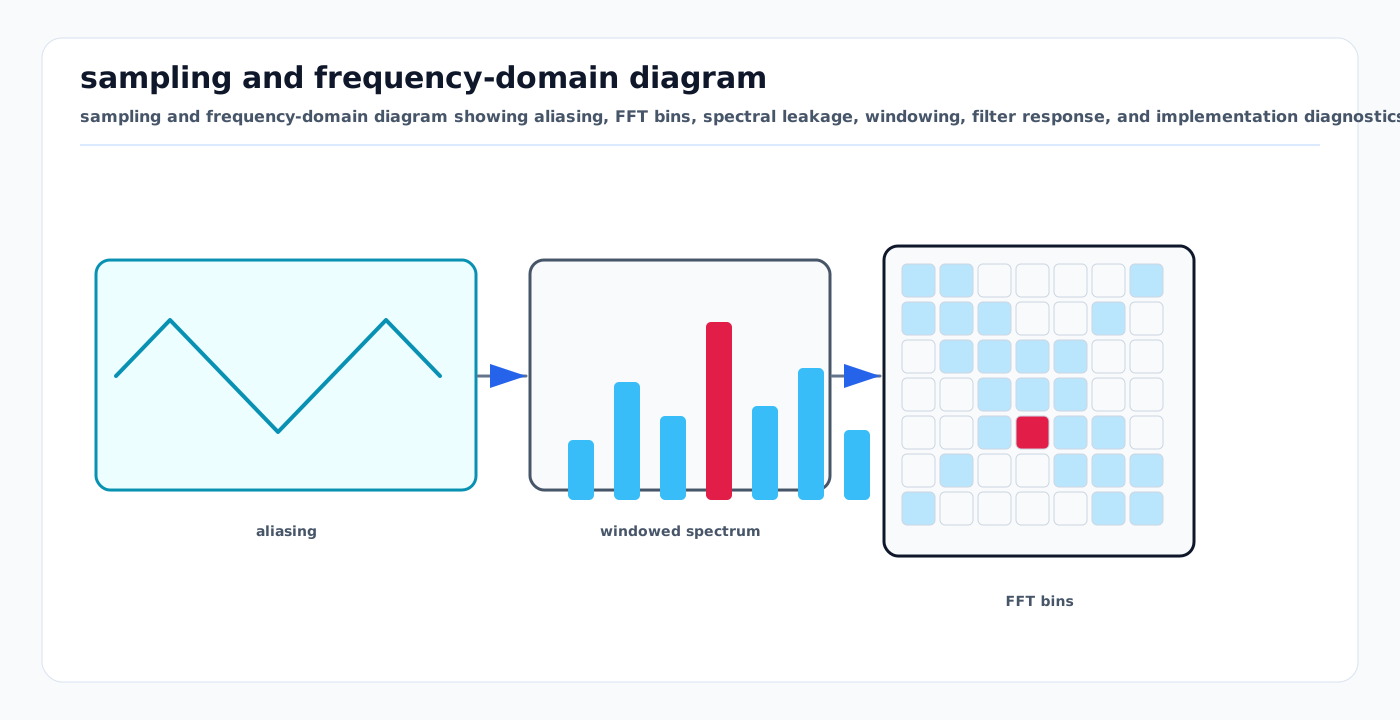
Visual: sampling and frequency-domain diagram showing aliasing, FFT bins, spectral leakage, windowing, filter response, and implementation diagnostics.
Sampling turns continuous sensor signals into discrete data. FFTs expose frequency structure. Windowing controls spectral leakage. Filtering shapes signal bandwidth, delay, and noise. The first-principles question is always: what information exists in the signal, what information did sampling preserve, and what did processing distort?
Related docs
- Radar Ambiguity, Chirp Design, and Doppler Limits
- CFAR Detection and Thresholding
- Sensor Filtering: Alpha-Beta, Kalman, and Complementary
- Sensor Likelihoods, Noise, and Error Budgets
- Time Sync, PTP, Timestamping, and Latency Models
Why it matters for AV, perception, SLAM, and mapping
Vehicle sensors are sampled systems. Cameras expose over finite intervals, LiDAR scans accumulate over rotating or solid-state patterns, radars sample ADC chirps, IMUs sample acceleration and angular rate, and wheel encoders quantize motion. Signal-processing choices affect detection latency, velocity estimates, map alignment, and filter consistency.
Bad sampling or filtering can create aliasing, phase lag, ringing, false peaks, or over-smoothed signals that look plausible but are late. In a moving vehicle, latency is a spatial error.
Core math and algorithm steps
Sampling and Nyquist
For sampling period T_s:
f_s = 1 / T_sA band-limited signal with maximum frequency f_max can be sampled without aliasing only if:
f_s > 2 * f_maxFrequencies above f_s / 2 fold into lower frequencies. This is aliasing, not noise. Anti-alias filtering must happen before sampling or before downsampling.
Discrete Fourier transform
For N samples x[n]:
X[k] = sum_{n=0}^{N-1} x[n] exp(-j 2 pi k n / N)Frequency bin spacing:
delta_f = f_s / NFor real-valued input, use a real FFT (rfft) and corresponding real frequency bins. Zero padding interpolates the displayed spectrum; it does not improve the true resolution set by observation time.
Windowing
The FFT assumes the finite block is periodic. If the block does not end at an integer number of cycles, discontinuities create spectral leakage. Windowing multiplies the data:
x_w[n] = w[n] * x[n]Tradeoffs:
| Window | Strength | Cost |
|---|---|---|
| Rectangular | narrowest main lobe | high sidelobes |
| Hann/Hamming | lower sidelobes | wider main lobe |
| Blackman/Blackman-Harris | strong sidelobe suppression | more resolution loss |
| Flat top | better amplitude estimate | wide main lobe |
Use FFT-periodic windows for spectral analysis and symmetric windows for FIR filter design.
Filtering
Linear time-invariant filtering:
y[n] = sum_k b[k] x[n-k] - sum_k a[k] y[n-k]FIR filters use only feed-forward terms. IIR filters use feedback and can reach sharp frequency responses with fewer coefficients, but they introduce nonlinear phase unless designed or applied carefully.
Common choices:
| Filter | Use | Risk |
|---|---|---|
| Moving average | quick smoothing | delay and poor frequency selectivity |
| Butterworth IIR | smooth passband | phase delay and stability at high order |
| Bessel IIR | phase behavior | slower rolloff |
| FIR linear phase | predictable delay | more coefficients |
| Median | impulse rejection | nonlinear, can distort dynamics |
| Savitzky-Golay | smooth derivatives | window assumptions can fail at edges |
Delay and phase
For real-time systems, filter delay is part of the measurement model. A linear phase FIR of length M has group delay:
delay = (M - 1) / 2 samplesForward-backward filtering can remove phase delay offline, but it uses future samples and is not causal. Do not use offline zero-phase filtering to estimate the latency of an online stack.
Basic processing checklist
choose sample rate from signal bandwidth and latency budget
anti-alias before ADC or decimation
remove invalid samples and saturations explicitly
window blocks before spectral estimation
scale FFT amplitudes consistently
filter with known passband, stopband, delay, and edge behavior
validate on synthetic signals with known frequency, phase, and amplitude
Implementation notes
- Use
scipy.fftfor FFTs andscipy.signalfor windows and filters. - Use second-order sections (
output="sos") for higher-order IIR filters to improve numerical stability. - Record sample time from hardware timestamps when available, not loop arrival time.
- Do not infer physical frequency from FFT index without
f_sandN. - Check units after every transform: ADC counts, volts, power, dB, meters, or radians.
- Treat missing samples and dropped frames as timing events, not ordinary zero-valued samples.
- Validate filter response with impulse, step, sine sweep, and known-noise tests before using it in a safety-relevant estimator.
Failure modes and diagnostics
| Failure mode | Symptom | Diagnostic |
|---|---|---|
| Aliasing | Low-frequency artifact from high-frequency source. | Repeat test at higher sample rate or with stronger anti-alias filter. |
| Spectral leakage | Energy smeared across bins. | Compare rectangular and tapered windows. |
| Wrong FFT scaling | Amplitude changes with N. | Test a sine wave with known amplitude. |
| Filter lag | Perception or control output arrives late. | Step response and group delay measurement. |
| Edge artifacts | Startup transient or replay boundary spike. | Inspect first and last window lengths. |
| IIR instability | Output grows or rings unexpectedly. | Check pole locations and use SOS implementation. |
| Offline/online mismatch | Lab results better than vehicle behavior. | Remove noncausal filtering from online-equivalent tests. |
Sources
- SciPy FFT documentation: https://docs.scipy.org/doc/scipy/reference/fft.html
- SciPy FFT tutorial: https://docs.scipy.org/doc/scipy/tutorial/fft.html
- SciPy signal processing API: https://docs.scipy.org/doc/scipy/reference/signal.html
- SciPy window generation documentation: https://docs.scipy.org/doc/scipy/reference/generated/scipy.signal.windows.get_window.html
- SciPy Butterworth filter documentation: https://docs.scipy.org/doc/scipy/reference/generated/scipy.signal.butter.html
- SciPy filtering with second-order sections: https://docs.scipy.org/doc/scipy/reference/generated/scipy.signal.sosfilt.html
- Smith, "The Scientist and Engineer's Guide to Digital Signal Processing": https://www.dspguide.com/