Continuous-Time Trajectory Splines and Gaussian Process Priors
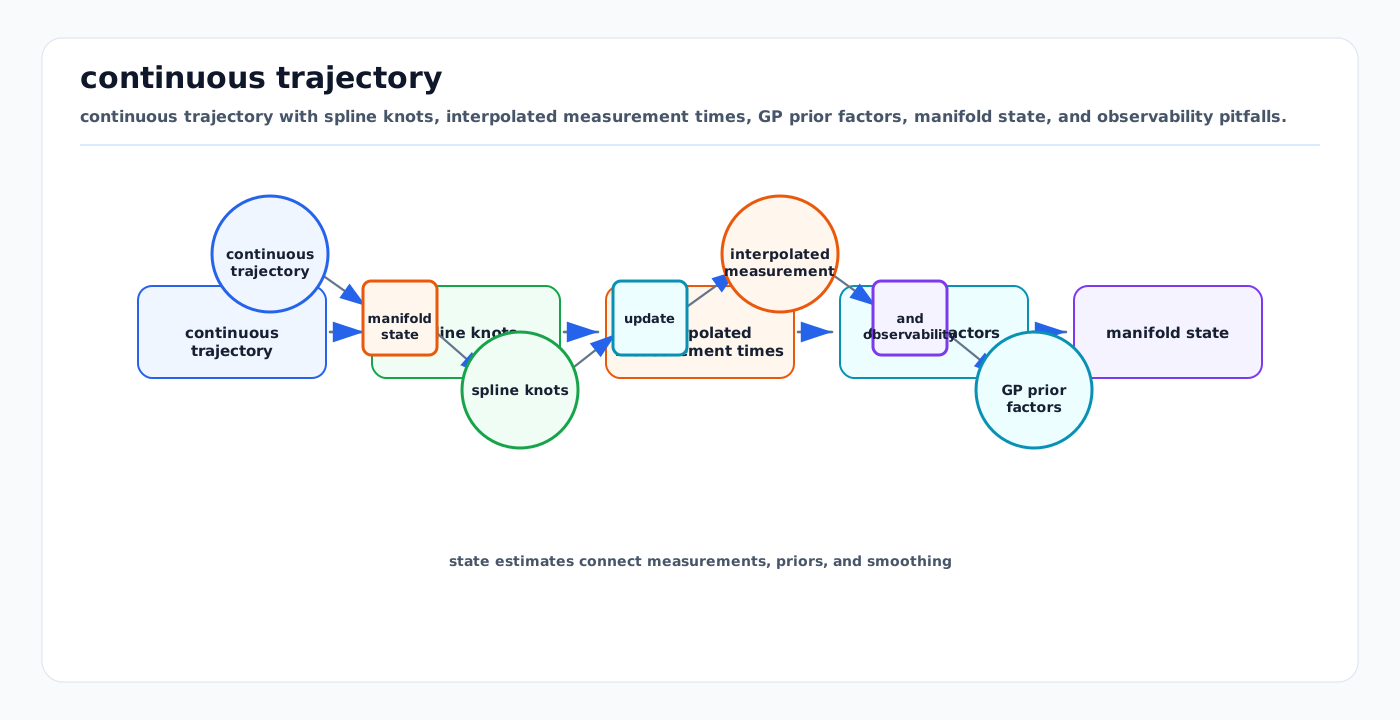
Visual: continuous trajectory with spline knots, interpolated measurement times, GP prior factors, manifold state, and observability pitfalls.
Most estimators pretend the robot state exists only at discrete keyframes. Real sensors do not. A rolling-shutter camera exposes rows at different times, a spinning LiDAR collects each point at a different azimuth time, an IMU samples at hundreds of hertz, and wheel/GNSS/radar measurements arrive asynchronously. Continuous-time trajectory estimation represents pose as a function T(t) so every measurement can be evaluated at its own acquisition time.
The practical question is not "continuous or discrete?" It is: what assumptions make the function between optimized states well defined, observable, and cheap enough to solve? Splines and Gaussian process (GP) priors are the two dominant answers.
1. Related Docs
- Lie Groups, SE(3), SO(3), and Jacobians
- Coordinate Frames, Projections, and SE(3)
- Sensor Calibration and Time Synchronization Fundamentals
- IMU Error Models and Preintegration
- GTSAM Factor Graph Optimization
- Nonlinear Least Squares from First Principles
- Sparse Matrices, Fill-In, and Ordering
2. Why Continuous Time Exists
For a measurement z_i acquired at time t_i, the residual usually has the form:
r_i = z_i - h_i(x(t_i), theta)where theta may include calibration parameters, landmarks, map variables, or time offsets. A discrete estimator must either:
- create a state exactly at
t_i, - interpolate between nearby states outside the optimizer, or
- assign
z_ito a nearby keyframe and absorb timing error into noise.
Continuous-time estimation makes the interpolation part of the model:
x(t) = Phi(t; c_0, c_1, ..., c_K)The variables c_k are control poses, knot states, or GP support states. The optimizer changes them, and every residual updates consistently.
This matters when:
- LiDAR scans bend because the platform moves during one revolution.
- Rolling-shutter rows are projected with the wrong camera pose.
- Camera, IMU, LiDAR, wheel, and GNSS samples have different rates.
- Calibration jointly estimates extrinsics and time offset.
- A map or replay tool needs poses at arbitrary timestamps.
3. State on a Manifold
For rigid-body motion, pose is not a vector in Euclidean space. It is an element of SE(3):
T(t) =
[ R(t)  p(t) ]
[ 0     1    ]
Small updates live in the tangent space:
T <- Exp(delta_xi) T
delta_xi in R^6
A continuous-time trajectory may model:
- position
p(t)and orientationR(t)separately, - pose
T(t)directly onSE(3), - velocity and bias states in addition to pose,
- calibration parameters as time-invariant variables.
The central constraint is that interpolation must respect the manifold. Linear interpolation of quaternion components or transformation matrix entries creates invalid motion unless followed by projection, and that projection changes the intended uncertainty.
4. Spline Trajectories
4.1 Intuition
A spline trajectory uses a small set of control variables to define a smooth curve. Local support is the key property: changing one control point affects only a bounded time interval. This keeps Jacobians sparse.
For scalar uniform B-splines:
x(t) = sum_j B_j,k(u) c_jwhere:
c_jare control points,B_j,kare degree-kbasis functions,uis normalized time between knots.
Higher degree gives smoother derivatives. A cubic B-spline is commonly used because it gives continuous position, velocity, and acceleration in vector spaces while retaining local support.
4.2 Pose Splines
For rotations or poses, a common construction composes local increments:
R(u) = R_i
       Exp(B_1(u) * log(R_i^T R_(i+1)))
       Exp(B_2(u) * log(R_(i+1)^T R_(i+2)))
       Exp(B_3(u) * log(R_(i+2)^T R_(i+3)))
Analogous cumulative formulations exist for SE(3). The exact convention depends on left/right perturbations and whether translation is interpolated in world, body, or group coordinates. Pick one convention and keep the Jacobians, velocity extraction, and residual definitions consistent.
4.3 Cost Function
A spline batch estimator solves:
min_c,theta  sum_i || z_i - h_i(Phi(t_i; c), theta) ||^2_Ri
             + smoothness_or_prior_terms
Smoothness may be implicit in the spline degree and knot spacing, or explicit:
E_smooth = integral || d^2 x(t) / dt^2 ||^2_Q dtThis says fast changes in acceleration are unlikely unless measurements demand them.
4.4 Knot Spacing
Knot spacing is a modeling choice, not just a compute knob.
| Knot spacing | Effect |
|---|---|
| Too wide | cannot represent fast turns, suspension motion, or scan distortion |
| Too narrow | overfits noise, weakens observability, increases solve cost |
| Nonuniform | useful for eventful intervals but complicates implementation |
A good rule is to make the trajectory bandwidth higher than the motion that must be corrected, then let measurement noise and priors suppress overfitting.
5. Gaussian Process Priors
5.1 First Principle
A GP trajectory treats state over time as a random function:
x(t) ~ GP(mu(t), K(t, t'))A motion prior defines which functions are likely. In continuous-time robotics, the GP prior is often generated by a stochastic differential equation:
x_dot(t) = A(t) x(t) + F(t) w(t)
w(t) ~ white noise with power spectral density Q_c
For a constant-velocity model in vector space:
d/dt [ p ] = [ 0 I ] [ p ] + [ 0 ] w(t)
     [ v ]   [ 0 0 ] [ v ]   [ I ]
The process noise says acceleration is unknown but bounded in distribution. Large Q_c allows agile motion; small Q_c enforces smooth motion.
5.2 Exactly Sparse Structure
Barfoot, Tong, and Sarkka showed that GP priors derived from linear time-varying SDEs can have exactly sparse inverse covariance when represented at support states. The prior between neighboring support states looks like:
r_k = x_(k+1) - Phi_k x_k
Q_k = integral Phi(t_(k+1), tau) F Q_c F^T Phi(t_(k+1), tau)^T d tau

cost_prior = sum_k r_k^T Q_k^-1 r_k
This is the same algebraic shape as a Markov process model or smoother:
x_k --prior-- x_(k+1) --prior-- x_(k+2)The GP interpretation adds continuous interpolation. For a time tau between support states i and i+1:
x(tau) = Lambda(tau) x_i + Psi(tau) x_(i+1)where Lambda and Psi are computed from the motion prior. Measurements at arbitrary times connect only to nearby support states, so the factor graph stays sparse.
5.3 GP vs Spline View
| Aspect | Spline trajectory | GP prior trajectory |
|---|---|---|
| Primary idea | deterministic basis functions | probabilistic motion prior |
| Smoothness | degree, knot spacing, regularization | process-noise spectral density |
| Uncertainty | added through residual weights | built into interpolation covariance |
| Locality | local basis support | Markov prior and local interpolation |
| Tuning knob | knot spacing and smoothness weight | support spacing and Q_c |
They are not enemies. Both are continuous-time priors. Splines are often easier to implement for calibration and rolling-shutter models. GP priors are often easier to connect to Kalman smoothing, uncertainty, and physical motion models.
6. How It Appears in Perception, SLAM, and Mapping
| Area | Continuous-time use |
|---|---|
| LiDAR SLAM | deskew every point by evaluating T(t_point) before registration |
| visual-inertial calibration | estimate camera-IMU extrinsic and time offset while fitting a smooth trajectory |
| rolling-shutter vision | project each image row using its exposure time |
| radar fusion | compensate detections using ego pose at radar acquisition time |
| dense mapping | integrate depth/range data into TSDF/occupancy maps at point time |
| incident replay | query aligned vehicle pose at any logged sensor timestamp |
Kalibr is a canonical example of the calibration use case: a continuous-time spline trajectory lets camera and IMU residuals share one motion model while extrinsics and temporal offsets are estimated.
7. Observability and Failure Modes
| Failure mode | Root cause | Symptom |
|---|---|---|
| Over-smooth trajectory | knots too far apart or prior too strong | deskew leaves curved walls and rolling-shutter residuals |
| Overfit trajectory | knots too close or prior too weak | motion explains sensor noise; calibration becomes unstable |
| Bad time offset estimate | motion lacks excitation or timestamps are inconsistent | low residuals with wrong extrinsics or phase lag |
| Wrong manifold convention | left/right perturbations mixed | optimizer diverges or velocities have wrong sign |
| Boundary artifacts | weak constraints at first/last knots | trajectory curls at log edges |
| Degenerate calibration motion | no rotations, no acceleration, planar-only scene | extrinsic/time parameters correlate strongly |
| Hidden latency | using receipt time instead of acquisition time | residuals grow with speed and yaw rate |
| Ignored covariance | all measurements weighted equally | high-rate sensor dominates even when biased |
Continuous-time models can hide problems by explaining them as motion. A trajectory that looks plausible is not proof that calibration, timing, and map geometry are correct.
8. Implementation Checklist
- Define time semantics: acquisition time, sensor clock, host clock, and offset.
- Store every measurement timestamp in a common time base before optimization.
- Choose support spacing from platform dynamics and scan/exposure duration.
- Use manifold-aware interpolation for
SO(3)andSE(3). - Derive analytic Jacobians or verify autodiff Jacobians against finite differences on the manifold.
- Add priors or fixed gauges for global pose, yaw, scale, and clock offset as required by the sensor set.
- Keep GP/spline support local so each residual touches only nearby states.
- Include boundary support states outside the measurement interval when using splines with finite support.
- Validate with synthetic data where the true trajectory, time offset, and calibration are known.
- Plot residuals versus timestamp, image row, LiDAR azimuth, speed, and yaw rate. Time errors usually appear as structured residuals.
- Stress test with high angular velocity, braking, bumps, and sensor dropouts.
- Export both optimized support states and a documented query function
T(t_query); downstream code should not reimplement interpolation casually.
9. Minimal Mental Model
Continuous-time estimation replaces:
measurement -> nearest posewith:
measurement timestamp -> trajectory query -> residualThe trajectory query is not bookkeeping. It is a prior about how the platform moved between optimized states. Spline models express that prior with basis functions; GP models express it with stochastic dynamics and covariance.
10. Sources
- Paul Furgale, Timothy D. Barfoot, and Gabe Sibley, "Continuous-Time Batch Estimation using Temporal Basis Functions": https://furgalep.github.io/bib/furgale_icra12.pdf
- Paul Furgale et al., "Continuous-time batch trajectory estimation using temporal basis functions": https://journals.sagepub.com/doi/abs/10.1177/0278364915585860
- Timothy D. Barfoot, Chi Hay Tong, and Simo Sarkka, "Batch Continuous-Time Trajectory Estimation as Exactly Sparse Gaussian Process Regression": https://arxiv.org/abs/1412.0630
- Sean Anderson, Timothy D. Barfoot, Chi Hay Tong, and Simo Sarkka, "Batch Nonlinear Continuous-Time Trajectory Estimation as Exactly Sparse Gaussian Process Regression": https://doi.org/10.1007/s10514-015-9455-y
- Jing Dong, Byron Boots, and Frank Dellaert, "Sparse Gaussian Processes for Continuous-Time Trajectory Estimation on Matrix Lie Groups": https://arxiv.org/abs/1705.06020
- Kalibr visual-inertial calibration toolbox: https://github.com/ethz-asl/kalibr
- Timothy D. Barfoot, Cedric Le Gentil, and Sven Lilge, "Revisiting Continuous-Time Trajectory Estimation via Gaussian Processes and the Magnus Expansion": https://arxiv.org/abs/2601.03360