Masked Modeling: First Principles
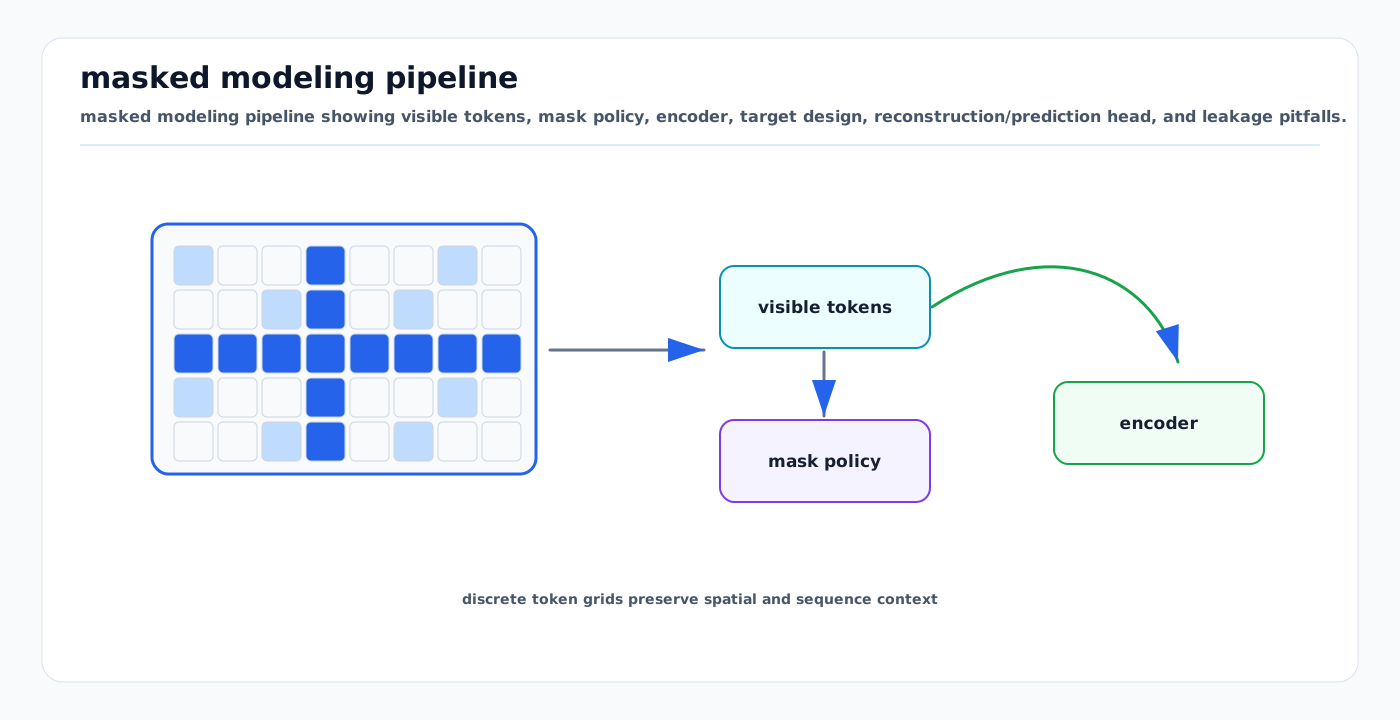
Visual: masked modeling pipeline showing visible tokens, mask policy, encoder, target design, reconstruction/prediction head, and leakage pitfalls.
Scope
Masked modeling trains a model to infer hidden parts of an input from visible context. It is the core idea behind BERT, BEiT, MAE, VideoMAE, point-cloud MAE, and many BEV/occupancy pretraining systems. This note explains the math, intuition, implementation interface, failure modes, and AV research relevance.
Related local notes:
- self-supervised-learning-first-principles.md
- vision-transformers-first-principles.md
- vqvae-tokenization.md
- jepa-latent-predictive-learning.md
1. The Core Idea
Given an input x, split it into visible and hidden parts:
x = {x_visible, x_masked}Train a model to predict the masked part:
prediction = f_theta(x_visible, mask_pattern)
loss = distance(prediction, x_masked)
The representation is useful if predicting missing content requires learning structure rather than memorizing local texture.
For AV data, the hidden part may be:
- text tokens in instructions or reports
- image patches
- video tubes
- LiDAR points or voxels
- BEV cells
- occupancy blocks
- map patches
- future frames or future occupancy
2. BERT: Masked Tokens
BERT masks some text tokens and trains a transformer encoder to recover them:
input:  "the vehicle stopped at [MASK]"
target: "stand"
Mathematically:
L = - sum_{i in M} log p_theta(x_i | x_not_M)where M is the set of masked token positions.
The key modeling choice is bidirectional context. A masked token can use both left and right context, unlike a causal language model that only uses the past.
AV use:
- parse airside instructions
- mine incident reports
- classify operator notes
- align route descriptions with scene observations
But BERT-style text masking does not directly solve metric perception. The visual and geometric versions need different masking, targets, and decoders.
3. BEiT: Masked Visual Tokens
BEiT adapts BERT-style pretraining to images. It creates two views:
image patches -> transformer input
image tokenizer -> discrete visual tokens as targets
The model sees corrupted image patches and predicts discrete visual token IDs:
L = - sum_{i in M} log p_theta(token_i | visible_patches)This is closer to language modeling because the target is a discrete token, not raw pixels.
The first-principles tradeoff:
Discrete targets can be semantic if the tokenizer is good.
They inherit tokenizer errors if the tokenizer is weak or domain-mismatched.
For AV scenes, a tokenizer trained on generic web images may not represent lane markings, cones, aircraft equipment, LiDAR range structure, or thermal imagery well.
4. MAE: Masked Autoencoding for Images
MAE masks a high fraction of image patches and reconstructs pixels. It uses an asymmetric design:
encoder: sees only visible patches
decoder: sees encoded visible patches + mask tokens
target: pixels for masked patches
Loss:
L = mean_{i in M} ||x_i - x_hat_i||^2The high mask ratio is important. If too much is visible, the model can solve the task by local interpolation. With large missing regions, it must learn object and scene structure.
For AV perception, MAE-style training can be applied to:
- camera images
- range images
- BEV features
- occupancy grids
- map tiles
- multi-camera mosaics
5. VideoMAE: Masked Tubes
VideoMAE extends MAE to video. Instead of masking independent image patches, it often masks spatiotemporal tubes:
video tensor: [time, height, width, channels]
mask unit:    same spatial patch across several frames
This makes the model infer motion and temporal consistency, not only spatial appearance.
AV video relevance:
- motion cues for pedestrians and GSE
- traffic-light or signal temporal state
- object permanence through occlusion
- future occupancy and flow features
- temporal robustness under sensor dropout
The mask design should respect ego motion. A static world point moves in image coordinates as the vehicle moves. Tube masking in raw image coordinates may not correspond to a fixed physical location.
6. First-Principles View of Mask Design
Masking defines the self-supervised task. The task defines what features the model learns.
| Mask pattern | Learns | Risk |
|---|---|---|
| random small patches | texture and local continuity | weak semantics |
| high-ratio random patches | object and scene structure | may lose small hazards |
| block masks | spatial completion | can over-smooth boundaries |
| tube masks | temporal motion and persistence | ego-motion mismatch |
| range-aware LiDAR masks | geometry completion | density shortcut |
| BEV region masks | map and occupancy context | blank free space dominates |
| future masks | prediction | future leakage if splits are wrong |
For AVs, mask sampling should overrepresent important but sparse structures:
- lane or stand markings
- curbs and boundaries
- cones and small obstacles
- pedestrians
- aircraft edges
- GSE attachment points
- occlusion boundaries
Otherwise the model can minimize average reconstruction loss by modeling easy background.
7. Target Design
Targets can be:
| Target | Loss | Strength | Risk |
|---|---|---|---|
| pixels | MSE or normalized MSE | simple, detailed | texture bias |
| discrete tokens | cross entropy | semantic compression | tokenizer bias |
| features | L2 or cosine | abstraction | teacher bias |
| depth/range | L1, Huber | geometry | sensor noise |
| occupancy | BCE or CE | planning relevance | class imbalance |
| flow | endpoint error | dynamics | ambiguous futures |
| map elements | CE or set loss | route relevance | stale map leakage |
The target should match the downstream use. If the downstream task is planning, predicting every pixel is often less useful than predicting occupancy, flow, or latent state. If the downstream task is sensor simulation, pixel or range fidelity matters more.
8. Implementation Interface
A masked modeling pipeline should make masking and targets explicit:
class MaskedBatch(NamedTuple):
    input: Tensor
    visible_mask: Tensor
    target: Tensor
    target_mask: Tensor
    metadata: dict

class MaskedModel(nn.Module):
    def forward(self, x_visible, visible_mask, target_mask, metadata=None):
        """Predict masked targets from visible inputs."""
        ...
For image MAE:
patches = patchify(images)                 # [B, N, P]
visible, target, mask = random_mask(patches, ratio=0.75)
z = encoder(visible, pos_visible)
pred = decoder(z, mask_tokens, pos_all)
loss = mse(pred[mask], target[mask])
For BEV occupancy:
bev = make_bev(sensor_batch, calibration, ego_motion)
visible_bev, target_bev, mask = mask_bev_regions(bev)
pred_occ = model(visible_bev, mask)
loss = class_balanced_ce(pred_occ[mask], target_bev[mask])
Metadata is part of the interface, not an afterthought. AV masked modeling often needs calibration ID, route ID, ego motion, timestamp, map version, and sensor health.
9. Data Splits and Leakage
Masked modeling is especially vulnerable to leakage because nearby frames are highly redundant.
Bad split:
random frames from the same route and day in both train and validationBetter split:
hold out by route, date, airport/site, weather condition, map version, and
sensor rig where possible
Future prediction requires stricter handling:
- do not let future map labels appear in current context
- do not use labels generated from future frames as "current" targets
- do not mix adjacent clips across train and validation
- keep teacher features generated by models trained on the validation set out of training
10. Evaluation Interface
Pretraining reconstruction loss is not enough.
Use:
- linear probe on frozen encoder
- few-label fine-tuning curves
- detection/segmentation/occupancy downstream tasks
- route/site/weather transfer
- small-object recall
- calibration perturbation tests
- sensor dropout and corruption tests
- latency and memory on target hardware
For masked BEV or occupancy models:
metrics:
  masked reconstruction IoU
  occupied-cell recall
  rare-class recall
  boundary F1
  free-space false negative rate
  downstream planner collision rate
  uncertainty calibration of occupied probability
11. Failure Modes
| Failure mode | Symptom | Mitigation |
|---|---|---|
| Local interpolation shortcut | low pretrain loss, weak downstream transfer | higher mask ratio, larger blocks, semantic targets |
| Texture bias | good image reconstruction, poor geometry | depth/range/occupancy targets and BEV probes |
| Blank-space dominance | model predicts empty occupancy | class-balanced loss and rare-region sampling |
| Tokenizer mismatch | BEiT-like target misses domain details | train tokenizer on target sensor/domain data |
| Ego-motion leakage | temporal task solved from misaligned artifacts | compensate motion and audit timestamp alignment |
| Future leakage | validation too optimistic | sequence/date/site splits and label provenance |
| Small hazard erasure | model smooths cones/FOD/pedestrians | hard sampling and small-object probes |
| Decoder overcapacity | decoder solves task without useful encoder | lightweight decoder and frozen-feature probes |
| Uncalibrated confidence | reconstructed probability is overconfident | temperature scaling and reliability checks |
12. AV and Research Relevance
Masked modeling is useful in autonomy because unlabeled sensor data is abundant and labels are expensive.
High-value applications:
- camera backbone pretraining for low-label airside perception
- LiDAR voxel or range-image pretraining
- BEV encoder pretraining for detection and occupancy
- map completion and map change detection
- video pretraining for temporal perception
- radar or thermal representation learning
- test-time adaptation with a bounded auxiliary loss
- world-model token or latent pretraining
For airside AVs, masked modeling is especially attractive because the target domain is visually and geometrically different from road datasets. Unlabeled airport logs can adapt features before expensive labeling.
13. Relationship to JEPA and Contrastive Learning
Masked modeling reconstructs hidden content:
context -> missing pixels/tokens/occupancyContrastive learning identifies matching views:
view A close to view B, far from negativesJEPA predicts hidden embeddings:
context -> target representationA practical AV curriculum can combine them:
1. contrastive pretraining for cross-modal and place invariance
2. masked modeling for spatial and geometric completion
3. JEPA or world-model objective for future prediction
4. supervised heads for detection, occupancy, mapping, and planning
14. Practical Checklist
Before training:
- Choose the physical unit to mask: image patch, range cell, voxel, BEV cell, map patch, or video tube.
- Choose targets that match downstream use: pixels, tokens, depth, occupancy, flow, features, or map elements.
- Split by sequence, route, date, site, and map version.
- Add metadata gates for calibration and time sync.
- Define downstream probes before looking at pretraining results.
During training:
monitor:
  masked loss by class and region
  visible/masked ratio
  rare-object reconstruction
  downstream probe score
  feature covariance
  failure examples by weather/site
Sources
- Devlin et al., "BERT: Pre-training of Deep Bidirectional Transformers for Language Understanding." arXiv:1810.04805. https://arxiv.org/abs/1810.04805
- Bao et al., "BEiT: BERT Pre-Training of Image Transformers." arXiv:2106.08254. https://arxiv.org/abs/2106.08254
- He et al., "Masked Autoencoders Are Scalable Vision Learners." arXiv:2111.06377. https://arxiv.org/abs/2111.06377
- Tong et al., "VideoMAE: Masked Autoencoders are Data-Efficient Learners for Self-Supervised Video Pre-Training." arXiv:2203.12602. https://arxiv.org/abs/2203.12602
- Goodfellow, Bengio, and Courville, "Deep Learning." MIT Press, 2016. https://www.deeplearningbook.org/
- Vincent et al., "Stacked Denoising Autoencoders: Learning Useful Representations in a Deep Network with a Local Denoising Criterion." JMLR, 2010. https://jmlr.csail.mit.edu/papers/v11/vincent10a.html