CFAR Detection and Thresholding
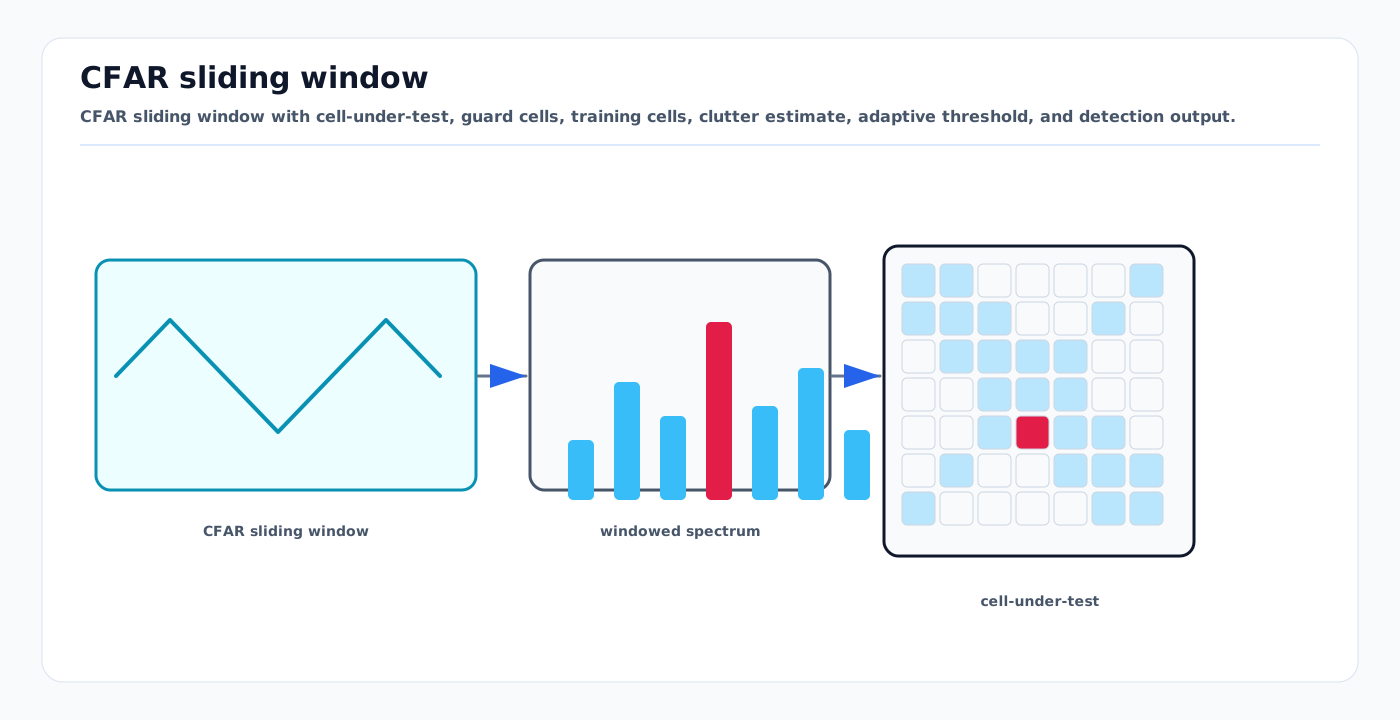
Visual: CFAR sliding window with cell-under-test, guard cells, training cells, clutter estimate, adaptive threshold, and detection output.
Constant false alarm rate (CFAR) detection adapts a threshold to the local noise or clutter floor. The first-principles reason is that a fixed threshold cannot work across all ranges, angles, weather, terrain, interference, and antenna sidelobes. CFAR decides what becomes a radar detection before tracking, classification, or fusion sees it.
Related docs
- FMCW, MIMO, and Doppler Radar Fundamentals
- Radar Ambiguity, Chirp Design, and Doppler Limits
- Sampling, FFT, Windowing, and Filtering
- Data Association and Gating
- Sensor Likelihoods, Noise, and Error Budgets
Why it matters for AV, perception, SLAM, and mapping
Radar perception begins with thresholding a range-Doppler-angle power field. If CFAR is too aggressive, low-RCS pedestrians, cones, FOD, and distant vehicles never become detections. If it is too permissive, trackers must handle a flood of clutter and ghosts. The threshold policy therefore changes object recall, false positives, track stability, and radar map quality.
CFAR parameters are also scenario-dependent. Airport aprons, highways, tunnels, wet pavement, parked aircraft, guardrails, vegetation, and rain all create different clutter statistics.
Core math and algorithm steps
Cell under test
For a power map P, define a cell under test (CUT):
P_cut = P[r, d]Use guard cells around the CUT so target energy does not contaminate the noise estimate. Use training cells around the guard region to estimate local clutter.
training cells | guard | CUT | guard | training cellsCA-CFAR
Cell-averaging CFAR estimates noise as:
Z = mean(training_cell_powers)
threshold = alpha * Z
detect if P_cut > threshold
For exponentially distributed noise power and N training cells, a common CA-CFAR scale for desired false alarm probability P_fa is:
alpha = N * (P_fa^(-1/N) - 1)This formula assumes independent homogeneous training cells. Real automotive radar often violates that assumption.
GO, SO, and OS-CFAR
| Variant | Rule | Useful when | Risk |
|---|---|---|---|
| CA-CFAR | mean all training cells | homogeneous background | fails at clutter edges and multi-target cells |
| GO-CFAR | use greater of leading/trailing estimates | clutter edge protection | can miss weak targets near clutter |
| SO-CFAR | use smaller of leading/trailing estimates | target masking reduction | more false alarms at clutter edges |
| OS-CFAR | sort training cells and use selected rank | interfering targets and nonhomogeneous clutter | rank and scale need tuning |
Ordered-statistic CFAR:
sorted_training = sort(training_powers)
Z = sorted_training[k]
threshold = alpha_os * Z
The rank k controls robustness against outliers inside the training window.
Two-dimensional CFAR
In range-Doppler maps, use 2D training and guard windows:
for each range bin r and Doppler bin d:
  collect training cells around (r, d), excluding guard cells
  estimate local noise/clutter
  compare CUT to threshold
Some stacks run CFAR separately by range and Doppler; others run 2D CFAR or apply CFAR after noncoherent antenna accumulation. The decision changes what weak or extended targets survive.
Detection post-processing
After thresholding:
group adjacent detections
keep local maxima
estimate SNR/noise floor
estimate angle for selected cells
attach Doppler, range, power, and covariance metadata
send detections to clustering or tracking
Peak grouping is not cosmetic. Without it, one physical target can produce many detections from adjacent bins and sidelobes.
Implementation notes
- Tune CFAR on power, not arbitrary display dB values, unless the algorithm is explicitly derived for log-domain statistics.
- Keep guard cells large enough for the main lobe and window sidelobes.
- Do not use training cells that cross known invalid regions, range wrap zones, or strong static leakage zones.
- Parameterize by range and angle when the noise floor varies over the field of view.
- Record per-detection threshold, estimated noise, SNR, and CFAR variant. These fields make downstream tracker failures explainable.
- Evaluate CFAR jointly with tracker metrics. A detector setting that improves per-frame precision may harm track continuity.
- Use replay slices with corner cases: rain, wet ground, tunnels, metal fences, aircraft, close bright vehicles, and sparse low-RCS targets.
Failure modes and diagnostics
| Failure mode | Symptom | Diagnostic |
|---|---|---|
| Target masking | Weak target near strong target disappears. | Inspect training cells contaminated by strong return. |
| Clutter edge false alarms | Detections line up along walls, guardrails, or ground transitions. | Compare CA-CFAR with GO/OS-CFAR in same region. |
| Too few guard cells | Threshold rises around true target. | Main lobe leaks into training cells. |
| Too many training cells | Local adaptation too slow. | Threshold ignores localized clutter patch. |
| Log-domain error | False alarm rate not close to design value. | Validate with simulated exponential noise. |
| Sidelobe detections | Multiple detections around one bright reflector. | Check windowing and peak grouping. |
| Nonstationary interference | Bursty false detections across many bins. | Time-frequency plots and raw ADC inspection. |
Sources
- Rohling, "Radar CFAR Thresholding in Clutter and Multiple Target Situations": https://ieeexplore.ieee.org/document/4102735
- Rohling radar CFAR overview slides: https://www.nato-us.org/sensors2005/papers/rohling.pdf
- OpenRadar CFAR documentation: https://openradar.readthedocs.io/en/latest/dsp/cfar.html
- OpenRadar Doppler processing documentation: https://openradar.readthedocs.io/en/latest/dsp/doppler_processing.html
- RadarSimPy CFAR example: https://radarsimx.com/wp-content/uploads/html/processing_cfar.html
- Richards radar signal processing topics: https://mrichards.ece.gatech.edu/tableofcontents/
- SciPy peak finding documentation: https://docs.scipy.org/doc/scipy/reference/generated/scipy.signal.find_peaks.html