Probabilistic Graphical Models and Message Passing
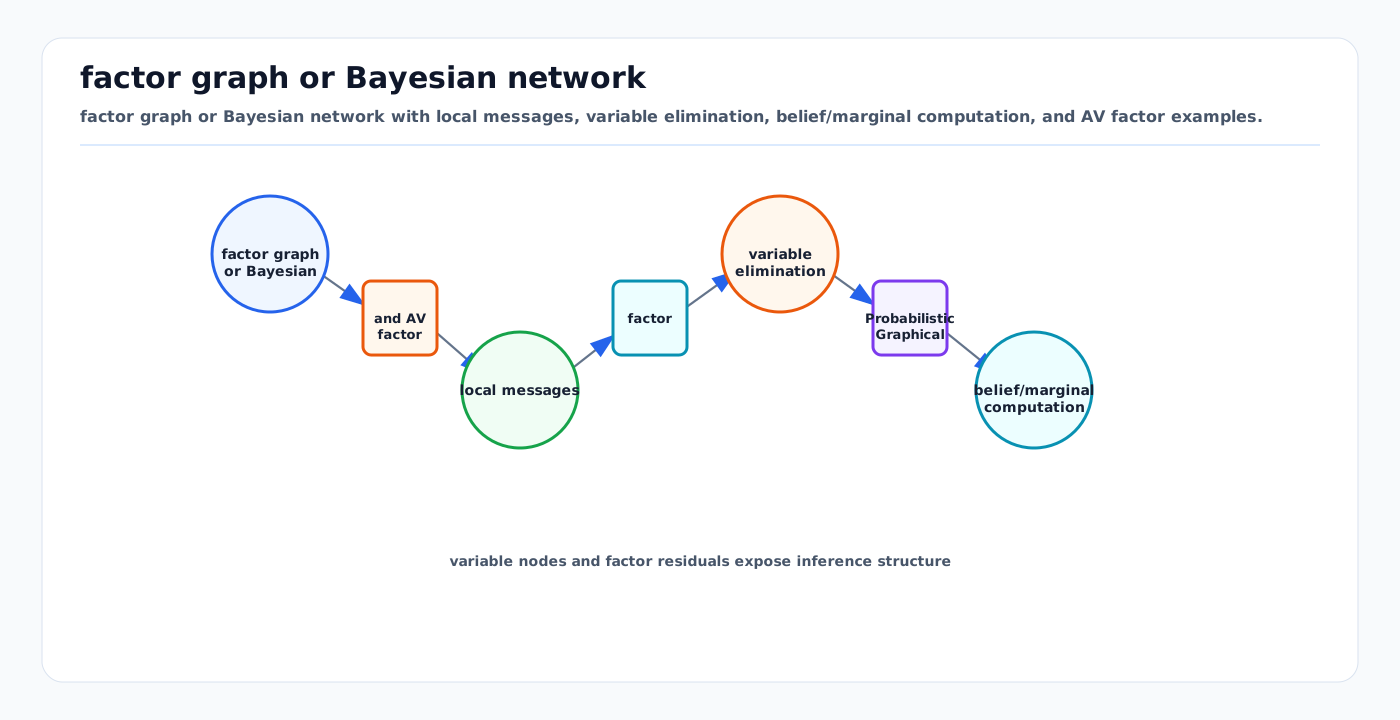
Visual: factor graph or Bayesian network with local messages, variable elimination, belief/marginal computation, and AV factor examples.
Probabilistic graphical models turn high-dimensional inference into local structure. Instead of writing one opaque joint distribution over every pose, landmark, object, map cell, latent token, and action, we represent how variables depend on each other and exploit that structure for estimation, learning, and planning.
Related docs
- Likelihood, MAP, MLE, and Least Squares
- Gaussian Noise, Covariance, Information, Whitening, and Uncertainty Ellipses
- Mixture Models and Multimodal Beliefs
- Bayesian Filtering and Error-State Kalman Filters
- Particle Filters and Hypothesis Management
- GTSAM Factor Graphs
- Factor Graph Solver Patterns: Ceres, GTSAM, and g2o
- Schur Complement, Marginalization, and PCG
- GLIM
Why it matters for AV, perception, SLAM, and mapping
Autonomy systems are full of local constraints:
- A camera measurement constrains one pose, one landmark, intrinsics, and extrinsics.
- An IMU preintegration factor constrains two poses, velocities, and biases.
- A track transition connects one object state at time
tto the same object att + 1. - A semantic map prior constrains nearby cells, lane boundaries, or object classes.
- A planner cost term touches a few trajectory states and controls.
The full posterior is large, but each measurement is local. Graphical models make locality explicit. Dellaert and Kaess describe factor graphs as a compact way to model large robotics inference problems, including SLAM, SFM, and sensor fusion, and emphasize that graph sparsity determines computational cost. The same representation also supports incremental inference, variable elimination, Bayes trees, and sparse linear algebra.
Core definitions
Random variables and evidence
Let
X = {x_1, ..., x_n}
Z = {z_1, ..., z_m}
where X are latent variables and Z are observations. In robotics, X may contain poses, landmarks, velocities, calibration parameters, object tracks, map cells, or latent world-model states.
The central inference target is usually:
p(X | Z)For planning or prediction, the target may instead be:
p(x_future | x_now, action_sequence, map, observations)Bayesian network
A Bayesian network is a directed acyclic graph. Its joint distribution factorizes as:
p(x_1, ..., x_n) = product_i p(x_i | parents(x_i))This is natural for causal generative models and temporal processes:
p(x_0:T, z_1:T) = p(x_0) product_t p(x_t | x_{t-1}) p(z_t | x_t)Kalman filters, hidden Markov models, and dynamic Bayesian networks are directed graphical models.
Markov random field
A Markov random field is an undirected graph. It represents local compatibility through clique potentials:
p(X) = (1 / Z) product_c psi_c(X_c)where Z is the partition function. MRFs are useful for spatial smoothness, label fields, occupancy regularization, and energy-based perception models.
Factor graph
A factor graph is a bipartite graph with variable nodes and factor nodes:
p(X | Z) proportional_to product_i phi_i(X_i)Each factor phi_i touches only a subset X_i of variables. In a Gaussian least-squares SLAM backend:
phi_i(X_i) = exp(-0.5 * ||r_i(X_i)||^2_{Sigma_i})Taking negative log probability gives:
argmin_X sum_i 0.5 * ||r_i(X_i)||^2_{Sigma_i}This is why factor graphs connect probability, optimization, and sparse linear algebra.
GLIM as a factor-graph example
GLIM can be read as the following graphical-model conversion:
Bayesian network:
  poses evolve over time, IMU constrains transitions, range observations depend on poses

Factor graph:
  X(i), V(i), B(i), and submap variables connected by IMU, scan-matching, loop, plane, and custom factors

Optimization problem:
  minimize whitened geometric and inertial residuals over active states or submaps
The Bayesian-network view is useful for explaining temporal dependence. The factor-graph view is more useful for implementation because loop closures, manual map corrections, plane constraints, GNSS/GCP anchors, and scan-matching costs are all just additional local factors. This is the bridge from probability to GLIM's GTSAM backend.
GTSAM Bayes net and Bayes tree interpretation
GTSAM starts from a factor graph because factors are the natural way to write measurement likelihoods. During elimination, that factor graph is transformed into a Bayes net: an ordered collection of conditionals. Grouping those conditionals by cliques gives a Bayes tree, which is the structure iSAM2 updates incrementally.
The important distinction is:
| Graphical object | Role in GTSAM/GLIM |
|---|---|
| Bayesian network | explains temporal generative structure such as state evolution and sensor measurements |
| Factor graph | implementation model for arbitrary measurement factors, loops, priors, and map constraints |
| Bayes net | result of eliminating variables from a linearized Gaussian factor graph |
| Bayes tree | clique-structured representation that lets iSAM2 re-eliminate only affected subtrees |
In GLIM, a loop closure can make a distant part of the trajectory probabilistically relevant again. In Bayes-tree terms, the affected cliques must be removed, turned back into factors, combined with the new loop factor, and re-eliminated. That is why loop closures can cause latency spikes even if the loop factor itself is small.
First-principles math
Conditional independence
Graphical models are useful because they encode conditional independence.
In a Markov process:
p(x_t | x_0:t-1, a_0:t-1) = p(x_t | x_{t-1}, a_{t-1})The current state is a sufficient statistic for the past. If this assumption is false because the state omits bias, intent, occlusion, map change, or weather, then the graph may look clean but the estimator will be overconfident.
Sum-product
Marginal inference asks:
p(x_j) = sum_{X \ x_j} p(X)On a tree-structured factor graph, exact marginal inference can be done by messages. For variable x and factor f, the variable-to-factor message is:
mu_{x -> f}(x) = product_{h in N(x) \ f} mu_{h -> x}(x)The factor-to-variable message is:
mu_{f -> x}(x) =
    sum_{X_f \ x} f(X_f) product_{y in N(f) \ x} mu_{y -> f}(y)
For continuous variables, the sum becomes an integral.
The marginal belief is:
b(x) proportional_to product_{f in N(x)} mu_{f -> x}(x)On trees, one forward-backward pass gives exact marginals. On loopy graphs, loopy belief propagation is approximate and may fail to converge, but can still be useful when loops are weak or damping is used.
Max-product and MAP
MAP inference asks for the most probable assignment:
X_star = argmax_X product_i phi_i(X_i)Replacing sums with maxima gives max-product:
mu_{f -> x}(x) =
    max_{X_f \ x} f(X_f) product_{y in N(f) \ x} mu_{y -> f}(y)
In log space:
m_{f -> x}(x) =
    max_{X_f \ x} log f(X_f) + sum_{y in N(f) \ x} m_{y -> f}(y)
This connects belief propagation to dynamic programming, Viterbi decoding, shortest paths, and discrete planning.
Gaussian message passing
For linear Gaussian models, factors are quadratic:
phi(x) proportional_to exp(-0.5 x^T Lambda x + eta^T x)where Lambda is information and eta is the information vector. Multiplying Gaussian factors adds information:
Lambda_total = sum_i Lambda_i
eta_total = sum_i eta_i
Marginalization eliminates variables. If the information matrix is partitioned as:
[Lambda_aa Lambda_ab] [x_a] = [eta_a]
[Lambda_ba Lambda_bb] [x_b]   [eta_b]
then eliminating x_b creates a Schur complement:
Lambda_marg = Lambda_aa - Lambda_ab Lambda_bb^-1 Lambda_ba
eta_marg    = eta_a - Lambda_ab Lambda_bb^-1 eta_b
This is the algebra behind landmark elimination in bundle adjustment, fixed-lag smoothing, and marginalization priors.
Variable elimination
Elimination rewrites the factor product by removing one variable at a time. Eliminating x_j gathers all factors touching x_j, summarizes their effect on the remaining variables, and creates a new factor:
new_factor(S) = sum_{x_j} product_{f in N(x_j)} f(scope(f))For Gaussian MAP, the analogous operation is sparse Cholesky or QR factorization. Elimination order controls fill-in: a bad order can turn a sparse SLAM graph into a dense matrix.
Algorithmic patterns
| Pattern | What it computes | AV use | Main risk |
|---|---|---|---|
| Forward-backward | exact marginals in a chain | HMM localization, map matching, temporal labels | Markov state may be incomplete |
| Kalman filter | Gaussian filtering in a chain | tracking, ego localization, sensor fusion | linearization and covariance mismatch |
| Rauch-Tung-Striebel smoother | smoothed Gaussian trajectory | offline localization, calibration logs | batch latency |
| Loopy BP | approximate marginals on cyclic graphs | occupancy grids, semantic maps, association | nonconvergence or false confidence |
| Max-product | MAP assignment | data association, discrete maneuvers | commits to one mode |
| Junction tree | exact inference after clustering | small discrete PGM subproblems | treewidth explosion |
| Variable elimination | MAP or marginals via ordering | SLAM, bundle adjustment, Bayes trees | fill-in and gauge issues |
| Incremental smoothing | update factorizations online | iSAM2-style SLAM | stale linearization and ordering policy |
AV, perception, SLAM, mapping, and planning relevance
SLAM and localization
SLAM factor graphs typically contain:
variables: poses, landmarks, velocities, IMU biases, calibration states
factors: priors, odometry, IMU, projection, scan matching, GNSS, loop closures
The graph answers both estimation and design questions:
- Which variables does each sensor constrain?
- Which degrees of freedom are weakly observable?
- Which factors introduce long-range loops?
- Which variables can be marginalized without making the graph too dense?
Multi-object tracking
Tracking can be written as a dynamic graphical model:
p(X_1:T, A_1:T | Z_1:T)where A_t are association variables. If associations are known, each track is almost a chain. If associations are unknown, the posterior becomes a mixture over assignments. This is why JPDA, MHT, particle filters, and learned association models exist.
Occupancy and mapping
Independent occupancy grids assume:
p(M | Z) = product_c p(m_c | Z)This is fast but ignores spatial correlation. MRF or factor-graph formulations can add smoothness, object-shape priors, dynamic flow, and map-consistency constraints. The tradeoff is compute and the risk of smoothing away thin or rare hazards.
World models and planning
A learned world model can be treated as a factorization:
p(s_0:T, o_1:T | a_0:T-1)
  = p(s_0) product_t p(s_{t+1} | s_t, a_t) p(o_t | s_t)
Planning then asks for action sequences that score well under predicted future beliefs. This is the same structural idea as model predictive control or belief space planning: roll forward a model, evaluate local costs, and update as new evidence arrives.
Implementation notes
- Design the variables before choosing a solver. A clean factor graph follows the conditional independences of the problem, not the class hierarchy of a library.
- Keep factor scopes small. Large factors may be statistically convenient but can destroy sparsity.
- Store factor units and noise models next to residual definitions. A graph with mixed meters, radians, pixels, logits, and grid cells needs explicit whitening.
- Use log probabilities or energies in software. Products of small probabilities underflow.
- Distinguish filtering from smoothing. Filtering estimates
p(x_t | z_1:t); smoothing estimatesp(x_0:t | z_1:t)or fixed-lag variants. - Track linearization points for nonlinear factors. Messages or Gaussian approximations are local around the point where Jacobians were computed.
- Treat marginalization as a model change. Marginal priors can become dense and can freeze old linearization errors into the active problem.
- Test each custom factor with finite differences, synthetic data, and perturbation checks before deploying it in a large graph.
Failure modes and diagnostics
| Symptom | Likely cause | Diagnostic |
|---|---|---|
| Posterior becomes overconfident | repeated correlated evidence treated as independent | audit factor independence and innovation statistics |
| Runtime grows sharply | fill-in from elimination order or large factors | inspect sparsity before and after ordering |
| Loopy BP oscillates | strong cycles or incompatible potentials | add damping, schedule messages, or solve as optimization |
| Map is oversmoothed | prior dominates measurements | compare per-factor cost and residual slices |
| Loop closure deforms map | false loop with overconfident covariance | replay with robust loss and loop residual histograms |
| Marginal prior destabilizes graph | stale linearization or dense prior misuse | check fixed-lag boundary variables and relinearization |
| Association flips tracks | MAP assignment collapses multimodal posterior | keep multiple hypotheses or soften association factors |
| Belief looks calibrated offline but fails online | graph omits latency, bias, weather, or domain state | add hidden state or condition noise by scenario slice |
Sources
- Frank Dellaert and Michael Kaess, "Factor Graphs for Robot Perception": https://www.cs.cmu.edu/~kaess/pub/Dellaert17fnt.html
- Frank Dellaert, "Factor Graphs and GTSAM: A Hands-on Introduction": https://repository.gatech.edu/entities/publication/0c2ac17c-1df4-48fe-8532-8f746868934a
- Frank Dellaert, "Factor Graphs: Exploiting Structure in Robotics," Annual Review of Control, Robotics, and Autonomous Systems: https://www.annualreviews.org/doi/10.1146/annurev-control-061520-010504
- Daphne Koller and Nir Friedman, "Probabilistic Graphical Models: Principles and Techniques," MIT Press: https://mitpress.mit.edu/9780262013192/probabilistic-graphical-models/
- Sebastian Thrun, Wolfram Burgard, and Dieter Fox, "Probabilistic Robotics," MIT Press: https://mitpress.mit.edu/9780262201629/probabilistic-robotics/